
Sex Is Not a Thing You Do, It’s a Place You Go To
Olivia Wilde’s third feature film as a director brings marital life into the forefront. Then, her appearance as actress in queer auteur Gregg Arakki’s first film in over a decade cemented 2026 as the summer of sex and intimacy discussions on screen.
A friend and I had tried our MUBI Go subscription on a Saturday night in Berlin, but as it was to be expected — on a steamy summer evening in July — a session of Olivia Wilde’s third directorial endeavor, the hilarious and poignant comedy drama The Invite (2026), was already sold out. So there we were the next day again in the afternoon, in an empty cinema in Berlin-Mitte that started filling up to 80% capacity by the film’s showtime. I had already watched an interview with two of the film’s stars, Penélope Cruz and Wilde herself, so I knew that Belgian psychotherapist and bestselling author Esther Perel had worked as a consultant for Cruz’s psychotherapist and sexologist role in the film. But what I witnessed that Sunday afternoon was something far more special than what that interview might have prepared me for.
The film originally premiered at the Sundance Film Festival in 2026, to a standing ovation that reportedly left Wilde wiping away tears onstage — "This was the dream, to premiere right here for you guys," she told the room, before A24 acquired the film outright for twelve million dollars. The premise, stripped down, sounds almost too slight to carry a feature: Joe and Angela (Seth Rogen and Wilde), a long-married couple whose relationship exists on what Wilde has called "a very powerful fault line of tension," invite their mysterious upstairs neighbours Hawk and Piña (Edward Norton and Cruz) over for what starts as an impromptu dinner and ends as something closer to group therapy conducted at gunpoint. It is, structurally, a 2026 Who's Afraid of Virginia Woolf? — but with polyamory instead of a fictional son, and imported Spanish ham instead of gin.
Piña is the character built directly out of the Perel consultancy, and it shows in the best possible way: not as a lecture bolted onto the plot, but as a woman who has simply absorbed a professional vocabulary so completely that it has become her personality. It's Piña who gets the line that gives this essay its title — delivered mid-dinner, mid-crisis, with the unbothered clarity of someone who has said it in session a thousand times: "Sex is not a thing you do, it's a place you go." Norton, who plays her husband Hawk, has said in interviews since that "a lot of what we took and liked from her work got personified in Penélope as Piña" — which tracks, because the whole point of Hawk and Piña within the film's architecture is to let Joe and Angela watch, in something close to real time, what Wilde has described as "the beauty in rupture and repair." Piña's sentence works precisely because nobody in the room, including her, is meant to find it comforting. It's a diagnosis dressed as a party trick.
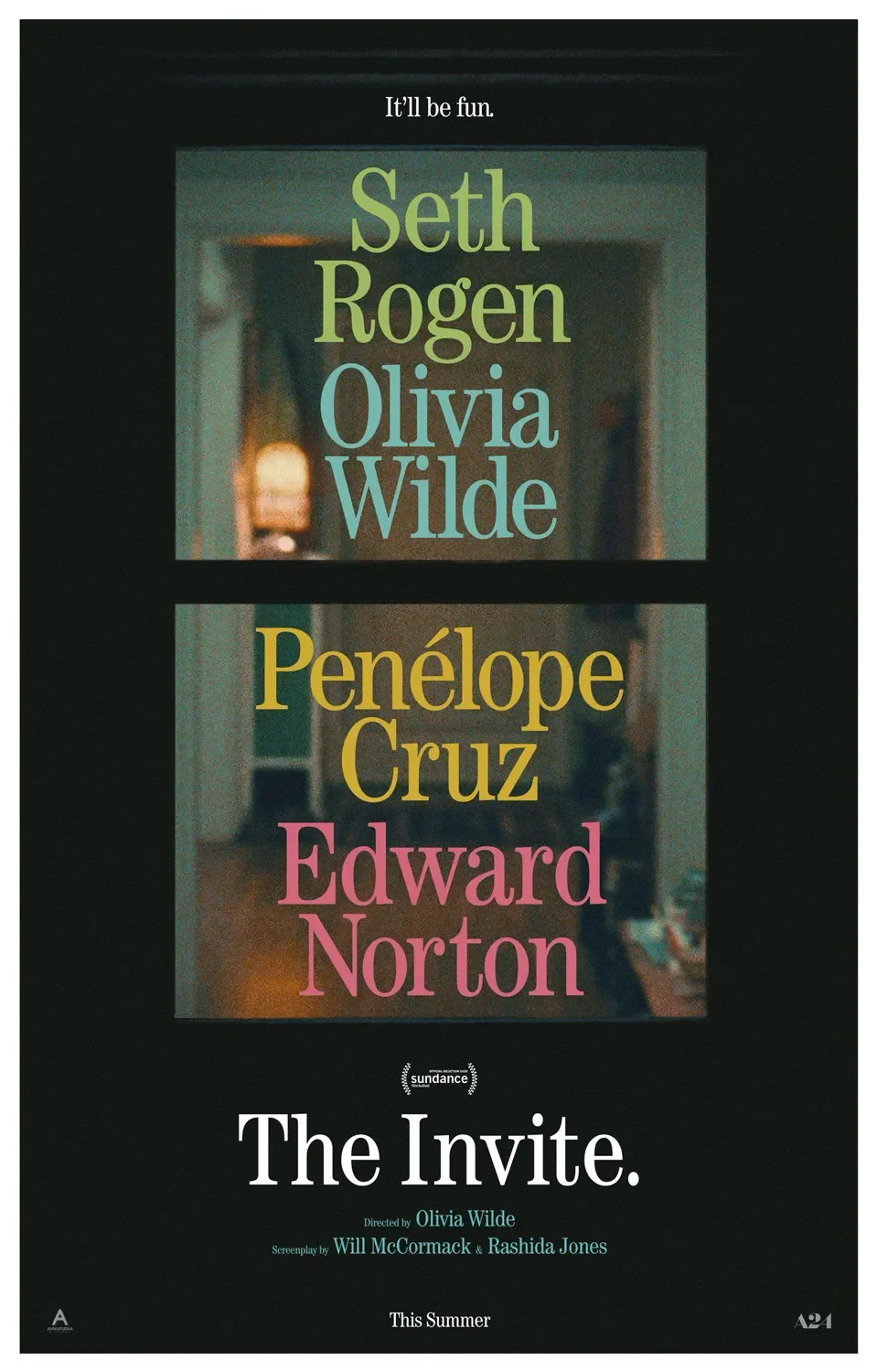
Image Description: Official poster for The Invite (2026), directed by Olivia Wilde. The design features a dimly lit window divided into two windowpanes, overlaid with the names of the lead cast — Seth Rogen, Olivia Wilde, Penélope Cruz, and Edward Norton — in large, colorful lettering, with the film's title in bold white text at the bottom.
Credit: A24
A few weeks later, on the other end of the same summer, Wilde herself becomes the subject of a version of the same sentence ("Sex is not a thing you do, it's a place you go"), rather than its author. In I Want Your Sex, Gregg Araki's first feature in over a decade, Wilde plays Erika Tracy, a gallerist-provocateur and artist who recruits Cooper Hoffman's wide-eyed Elliot as her "sexual muse" — a woman being studied, and eventually feared, rather than one dispensing wisdom from a position of hard-won stability. At one point, while gluing chewed-up gum onto a supposed installation of a drawing made to look like a vagina, Elliot makes a declaration too often heard by supposedly liberal men in the global cities of the North: "I have a girlfriend, but I definitely identify with the queer community" — rebuked in hilarious delivery by Zap (Mason Gooding) through the Socratic question of "Have you ever sucked a dick?".
The film makes acid social critique in a fully humorous way that sometimes makes it even more politically sagacious than it might have been originally intended. Araki's own cultural observations — made from the point of view of a borderline boomer born into Gen X — as to how Gen Z is no longer participating in an active sexual exploration necessary for human development carry greater anthropological analysis than many academics might be attempting right now. I Want Your Sex also features an appearance from pop star Charli XCX's ever-growing acting portfolio, playing the seemingly frigid Minerva, whom we get to see post-breakup with Elliot enjoying an afternoon with a Hot Naked Guy (credited as Daniel Stevens, aka Christian Wilde, the adult gay performer, who makes a cameo offering a full frontal glimpse of himself).
Margaret Cho is surprisingly tame here in the role of a cop, but somehow I think this was an intentional choice (perhaps from Araki himself), and it pays off. Her deadpan line delivery makes the comic effect of Elliot's absurd arrangement with Erika, and its tragic consequences, seem even more outlandish. Araki also confessed to journalists before that Elliot is based on his early 20s self, when he was experiencing his sexual awakening, whilst Erika is partly inspired by his own post-fame interview bravado.
"Sex is not something you do. It's a dance. It's a language." Here said by Erika's French friend Yvette (Roxane Mesquida) to whom Elliot is offered as a sexual gift, but to which she abruptly declines due to his “too American” approach to sexual liberation. A phrase echoing the other film motto of this Olivia Wilde summer, said by Penélope Cruz's psychotherapist character Piña — sex not as a thing you do, but a place you go to.

Image Description: Promotional poster for I Want Your Sex (2026), directed by Gregg Araki. Against a vivid pink background, Olivia Wilde stands in profile wearing a black latex outfit and holding a BDSM flogger, while oversized blue and white typography dominates the composition with the film's title, cast names, and enthusiastic review quotes.
Credit: Magnolia Pictures / Black Bear Pictures
Erika, and the people who actually talk like her
It's funny because Wilde's character would fit just perfectly at a hip gallery in New York or Berlin. Erika is supposed to be a pastiche, but I've heard the pseudo-revolutionary phrases she utters from a number of real gallerists and other cultural workers in Berlin. She's narcissistic, entitled, and speaks the language of textbook intimacy without real consent. Like the pharmacopornographic society dissected by Paul B. Preciado, it no longer matters to embody sexual experience and gender deconstruction, but merely to learn the language adjacent to it.
Even though I was born in 1991, Alan Shapiro’s 1993 The Crush with Alicia Silverstone (as Adrian/Darian Forrester) and Cary Elwes (as Nick Eliot) would greatly impact my sexual awakening later in my teenage years. The film’s mix of Lolita and Fatal Attraction heavily influenced how I perceived puppy love and problematic crushes. Now, with Gregg Araki’s first foray since his last film in twelve years, White Bird in a Blizzard (2014), sex, lies and contemporary art’s fake innuendos are met through Tracy — perhaps with a complexity that directors like Shapiro would not be able to carry.
I wondered on whether I Want Your Sex had been directed by a white, straight filmmaker, if Erika would have been explored in a vastly different manner. And I think definitely so, because the femme fatale trope — like I’d experienced being depicted in my early teenage years through Alicia Silverstone’s performance in The Crush — was both an object of desire to the male gaze but also a dangerous liaison to the bourgeois constructs of heterosexuality, marriage and nuclear family. Silverstone’s character is committed to an asylum, where she continues to fixate on her doctor, while in turn Erika fakes her own death to overcome the public humiliation of her artistic career being canceled. Where one woman is condemned and institutionalized for her wickedness, the other not only survives but gets to enjoy a new relationship with a non-English speaking stud called Jesus.
Through Araki’s queer gaze the femme fatale trope is contextualized and reconfigured in a camp aesthetic, which makes her choices impossible to narrowly define as inherently wicked or conniving. As a boundary-pushing art world icon, Wilde’s catch-me-if-you-can performance leaves viewers to question if Erika is an abusive predator, a liberating mentor, or merely a satirized stereotype of those same New York and Berlin gallerists I’m tired of meeting. By the end of the movie, I still couldn’t place her in just one of those categories.



One sentence, two verdicts
What strikes me most, sitting with both films back to back the way this Berlin summer arranged them for me, is that neither one resolves the sentence it keeps repeating. Piña gets to say "sex is a place you go to" with the calm of someone who has, apparently, arrived there — the film frames her and Hawk's rupture-and-repair as aspirational, even as it shows how much devastation sits underneath that calm. Yvette echoes the same proposition back at Elliot, but it curdles into contempt rather than diagnosis — for a man who has confused enthusiasm for fluency, and for the woman he's been offered to as though fluency were beside the point. One film offers the sentence as therapy; the other offers it as rebuke — from two different women, to two men who weren't really listening either time. Both agree that the sentence is true. Neither pretends that agreeing with it is the same as living it.

Image Description: A still from Gregg Araki’s I Want Your Sex showing Elliot, a red-haired young man, lying on his side on a bed, resting his head on a gray blanket. He wears a bright pink pig-shaped mask pushed up on his head and appears to be looking directly toward the camera with his mouth slightly open, in what looks like a display of pleasurable surrender. A blue garment is visible around his neck, while one hand rests near his face. The intimate, playful image combines soft bedding and close-up framing with the deliberately provocative, surreal styling associated with the film.
Photo credit: © Magnolia Pictures