
Proud: a Polish TV Series Making History
A gay man, Filip Raczyński, parties his way through Warsaw until a family tragedy hands him a baby and a country’s entire legal machinery turns against him. Eight episodes later, Proud has become the most-discussed Polish television event of the year — not only for what happens on screen, but for what its lead actor said off it. What does it mean for a nation to finally tell this story, and what does it cost the person telling it?
Filip Raczyński does not want to grow up. He is a model, he is beautiful, he knows it, and for the first stretch of Proud he treats his life as an extended party with no closing time. Then his sister Anka dies, and he is left holding her infant daughter, Tosia, in a country whose laws were never written with a gay man's parenthood in mind. What follows across eight weekly episodes on HBO Max is, depending on who you ask, an intimate family drama, a piece of activist television, or both at once. Created by Karol Klementewicz and Monika Pęcikiewicz, Proud premiered on June 12, 2026, closed its first season on July 31, and arrives already carrying the Grand Prix of the Séries Mania festival in Lille, along with a Best Actor award for its lead, Ignacy Liss.
It is worth pausing on what Proud actually is before saying what it means. This is not a coming-out story — Filip’s sexuality is simply a given, one color among several in a much messier portrait, as more than one Polish critic has pointed out. The series is closer to a study of improvised, chosen family: a chaotic young man forced to become someone a child can rely on, surrounded by friends and neighbours who are just as flawed as he is. The Guardian’s Jack Seale gave it four stars, calling it a darkly funny, socially engaged portrait of the difficulty of being a gay father in Poland — praise echoed by outlets across Europe once the show left the festival circuit and reached streaming audiences directly. Writing right after the finale aired, the half-Polish author and publishing consultant Jon Malysiak captured something similar from an outsider’s vantage point, describing the series as an act of cultural courage precisely because it refuses to turn its more conservative characters into villains, choosing instead to let the humanity of its characters expose the injustice around them.
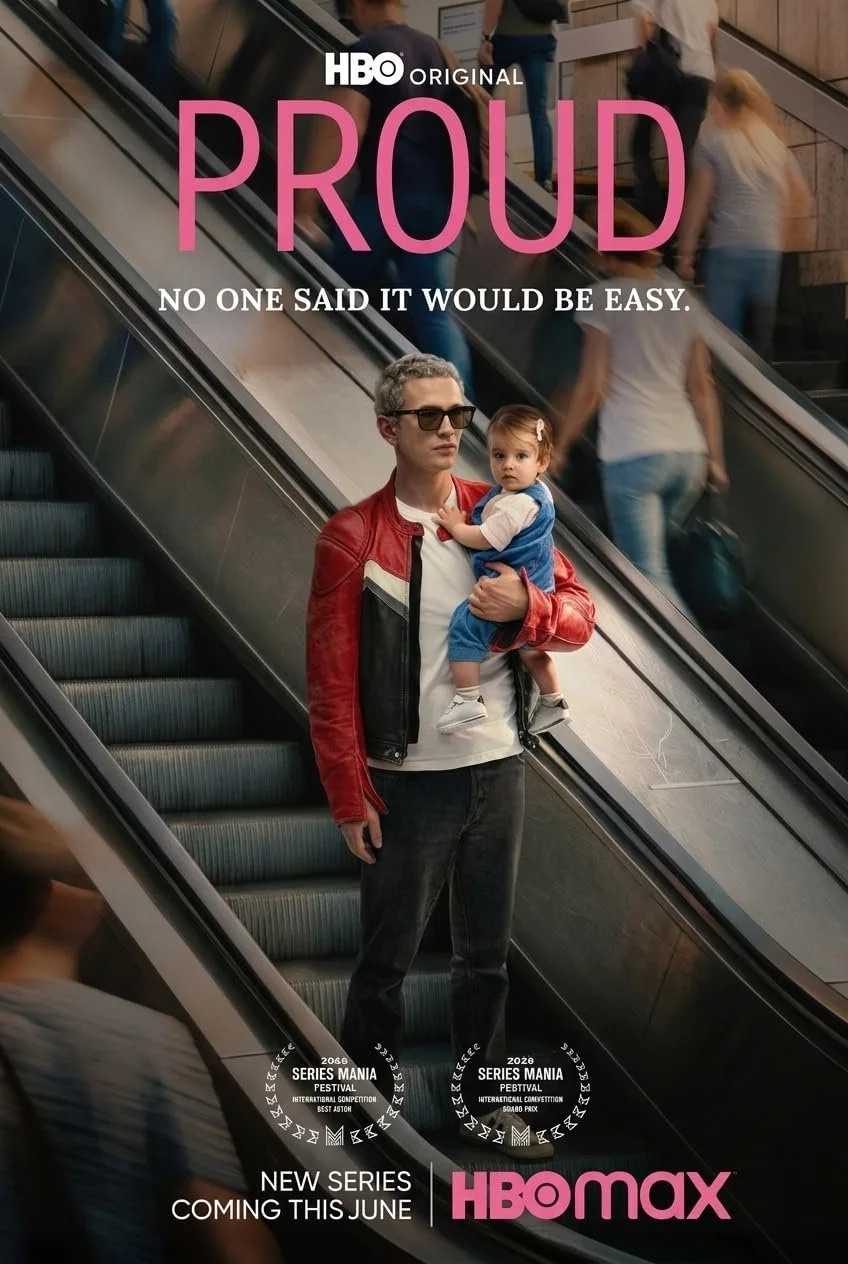
Image Description: Promotional poster for Proud (2026), an HBO Original series. Against the backdrop of a busy escalator, a young man with short blond hair, sunglasses, and a red leather jacket stands still while holding a small child in his arms. The title Proud appears in large pink letters above the tagline, “No One Said It Would Be Easy,” with HBO Max branding and festival laurels at the bottom of the poster.
Credit: HBO Max / Warner Bros. Discovery
The first of its kind
What makes Proud historically significant is less its plot than its existence. It is the first Polish television series built around an openly gay protagonist and his search for legal fatherhood, produced not by an independent studio but by TVN Warner Bros. Discovery for HBO Max — a mainstream platform, in a country where, as Wikipedia’s overview of LGBTQ rights in Poland notes, same-sex couples still cannot adopt and the constitution still defines marriage as heterosexual. That a series about exactly this legal impasse could be filmed, funded, and broadcast at all is itself a kind of argument. Director Klementewicz has described the show less as a political statement than as “a chosen family” story — but in Poland, telling that story on national screens is inseparable from politics, whether the writers intended it that way or not.
Episode six: when the personal becomes a spectacle
If the earlier episodes let Filip’s transformation unfold gradually — grief, hangovers, a baby who needs feeding at three in the morning — episode six is where the show stops being gentle. Faced with a bureaucratic ruling that would send Tosia to a children’s home rather than leave her with her gay uncle, Filip does the only thing left to him: he runs. What was already a domestic drama becomes, almost overnight, a media circus involving police and social workers, a fugitive father and daughter chased across the country while cameras and officials close in. Without giving any spoilers as to where this all lands, I’ll leave it at that.
This is, to my mind, the most openly activist hour the series has produced. It stops implying that the system is inadequate and starts dramatizing the exact mechanism of its failure: a man who loves a child unconditionally, with no legal standing to prove it. The episode doesn’t argue this in dialogue or speeches — it simply lets the procedure play out to its logical, absurd end, and trusts the audience to feel the injustice of it without being told. That restraint is, I think, exactly what makes it effective as advocacy rather than propaganda: it never stops being Filip’s story first.
A European argument the show never quite makes
Poland retains 39th place out of the countries surveyed in ILGA-Europe’s Rainbow Map 2026, with a score of 22 percent — among the very lowest in the European Union, just above Bulgaria and Romania. A cohabitation bill has moved through parliament this year as a modest concession, and Polish courts have only recently begun, under pressure from the Court of Justice of the EU, to recognise same-sex marriages performed elsewhere in the bloc. In other words: the same European Union that presents itself, in its own charters and speeches, as a community bound by shared commitments to gender and sexual equality is, on the ground, nothing of the sort.
Estonia became the first post-Soviet state to legalise same-sex marriage in 2024; in that same window, Italian prosecutors were attempting to strip non-biological mothers from their own children’s birth certificates, a move Italy’s courts eventually overturned. Meanwhile the EU’s Horizontal Anti-Discrimination Directive, first proposed back in 2008, still sits blocked in Council after seventeen years, member states endlessly invoking “national competence” to withhold the unanimity it needs. A couple married in Berlin can find their union unrecognized the moment they cross into Poland; a Polish gay man raising his niece has no legal vocabulary for what he is doing. I made a version of this argument, at much greater length, in a manuscript currently under review at the European Journal of Cultural Studies — the claim there, stripped of its footnotes, is that the Union has become very fluent at the language of inclusion while leaving the actual distribution of power largely undisturbed: recognition arriving well ahead of redistribution, symbolism outrunning structure. "Proud" makes a version of the same point without a single citation. It just shows you the paperwork Filip cannot produce.
This, to me, is the real argument for what a television series can do that legislation cannot. Legal reform in Poland on questions of adoption or marriage will likely take years, quite possibly a decade or more, moving at the glacial pace institutions always move at. A show like “Proud,” reaching people in their living rooms on a Friday night, can shift a felt sense of what is normal and who deserves protection long before any statute catches up. Audiovisual culture doesn’t replace the slow work of law and policy, but it can prepare the emotional ground for it — and sometimes that preparation is the harder, more necessary part.
The actor who complicated his own show
None of this unfolded in a vacuum, and I don’t want to pretend it did. Around the time of the premiere, Ignacy Liss — playing Filip, the show’s gay lead — gave an interview in which he said he was not a supporter of Poland’s Equality Parade, comparing it unfavourably to the nationalist Independence March and suggesting it was “better to speak gently and intimately about something than to shout.” The remarks landed badly. Polish commentators and LGBTQ+ outlets accused him of a glaring hipocrisy — benefiting from a role built on decades of activism while distancing himself from the activism itself — and the backlash grew large enough that Liss later gave a clarifying interview in which he admitted, plainly, that while he did not consider himself homophobic, his language in that moment had been.
I don't think this episode is a footnote to the show; I think it belongs inside any honest reading of it. A Polish friend of mine told me that watching “Proud” left him genuinely unsettled — not by the story, which he loved, but by the discomfort of watching Liss inhabit a role of quiet, dignified gay fatherhood on screen while knowing what he’d said about the movement that made his character’s existence thinkable in the first place. That discomfort seems worth sitting with rather than resolving too quickly. It sharpens, rather than settles, the long-running debate about straight actors playing gay roles: the argument for casting the best actor for the part gets considerably harder to make when that actor turns around and questions, however briefly, the political struggle his character depends on. “Proud” doesn't ask this question of itself. Its reception has asked it for the show.
The finale’s quiet argument about “traditional” families




The season finale sharpens this into something more pointed than the show has attempted before, and it does so through a single new character: Olga Nowak, played by Dorota Kolak. Olga is Tosia’s biological grandmother — mother of Krzysztof, Anka’s former boyfriend, who has shown no interest whatsoever in raising the daughter he fathered. Filip is invited — and brings his friend Kiki (Maria Sobocinska) along for emotional support — to what turns out to be Olga’s birthday dinner, where Krzysztof shows up as an unannounced surprise to both sides — and the meal collapses into open family warfare, Olga at one point yanking the tablecloth clean off the table, sending glasses and plates crashing to the floor in front of her stunned guests. It’s in the wreckage of that scene that we learn Olga has petitioned the court for Tosia’s adoption, presenting herself, implicitly, as the “proper” family structure a child deserves — a married-in bloodline, a grandmother, none of the legal ambiguity attached to Filip’s claim.
The season ends with Filip walking into a courtroom for a verdict the show declines to give us. But by then the finale has already done its real work, because during the hearings it emerges that Olga has her own history: as a young mother she once left Krzysztof, drunk, abandoned on a beach when he was six years old. The “traditional” structure, in other words, turns out to conceal its own instability; the household form that looks safest on paper is not obviously the one that kept a child safe in practice. This is where the show’s politics become legible without ever being stated outright — it refuses to let heteronormativity stand in as a synonym for a child’s wellbeing, and instead lets Filip’s chaotic, non-biological, queer household argue for itself simply by being the place where Tosia has actually been cared for. It’s hard not to read this through Jack Halberstam’s notion of “queer time and space” — family and care organized outside the reproductive, generational logic that courts and social workers are trained to recognize as legitimate. Filip’s household has no script to follow; it improvises kinship in real time, on its own clock, and that improvisation is precisely what the Polish legal system has no category for. Whether the show’s fictional court can see that is left, pointedly, unresolved — much like the real one.
What the series leaves behind
Season one of “Proud” ends, as these things tend to, without resolving very much — a court date looms, family arrangements remain provisional, nothing about Filip’s legal position is secure. That unfinished quality feels honest rather than evasive. Poland’s institutions have not resolved this either, and a television series pretending otherwise would have betrayed the very realism that made episode six land as hard as it did. What “Proud” has done, more modestly and more durably, is put a specific, believable, difficult person in front of a national audience and ask them to want good things for him. Given how slowly the law tends to move, that might turn out to be the more consequential achievement.
Photo credit: © Agnieszka Jurek-Opalińska/HBO Max