
September 11, Memory, and the Morning Pluto Moved into Aquarius
Twenty-five years since the towers fell, a psychological theory about memory gave way to a mayor's decision to release 170,000 pages, and the essay I planned became one I hadn't. Do you remember where you were on September 11, 2001?
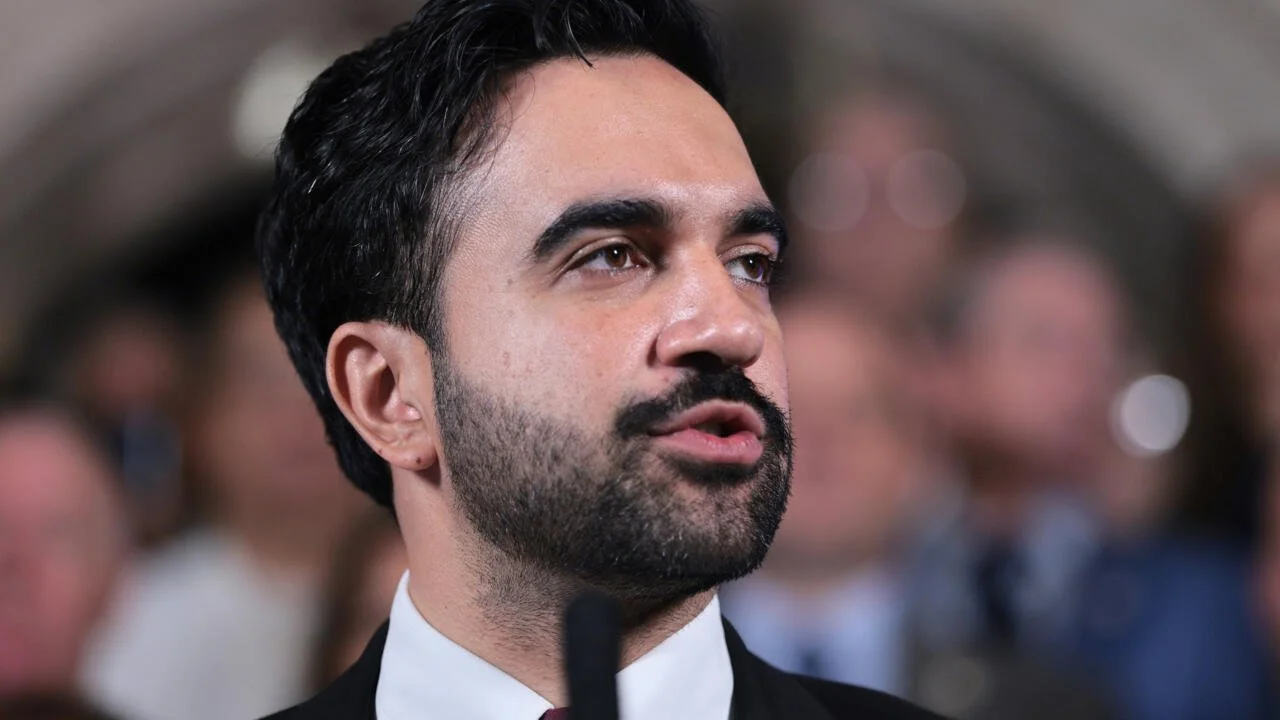
Image Description: A close-up photograph of New York City Mayor Zohran Mamdani speaking into a microphone during a press conference marking the 25th anniversary of the September 11 attacks. Dressed formally in a dark suit and white shirt, he looks slightly upward and away from the camera while speaking, with a softly blurred crowd visible behind him.
Credit: © Michael M Santiago/Getty Images via AFP
I had planned to write this text about a memory disorder. Not a disorder of forgetting but its opposite: hypermnesia, the clinical name for a recall that is too much, too bright, too complete. In the older French psychiatric literature, traumatic or emotional hypermnesia described the way certain events refuse the ordinary erosion that time performs on everything else, and instead remain lodged in the mind with a fixity that feels less like remembering than like still being there. It is a concept that sits very close to what cognitive psychology, since Roger Brown and James Kulik’s 1977 paper, has called the flashbulb memory: the sense that a single moment of receiving news has been photographed onto us, with the light still on. I wanted to write about what it means for a city, and for a world, to carry a flashbulb for twenty-five years. That was the plan.
Then, on Tuesday morning, three days before the anniversary, the Mayor of New York stood at City Hall and settled two lawsuits, opened a public portal, and released the first 170,000 pages of what his own administration called documents that show ‘what the city knew about the toxic air around Ground Zero, when they knew it, and how they acted to limit liability’. And the essay I had planned quietly stopped being possible. The psychological reading was no longer sufficient. What happened on Tuesday was not a memory event but a memory act, a deliberate reversal of the direction in which a state usually handles its own record, and for that I have no vocabulary as precise as the one I usually keep for the second half of my essays, the occultural one. So I will not keep it there this time. This is the most ambitious text I have written for my website, in the sense that I intend to use the whole of my language at once: the psychological, the somatic, the performer's, the astrological, the spiritual. If it reads as too much, that is, I think, the correct register for a flashbulb.
Let me begin, though, where I meant to.
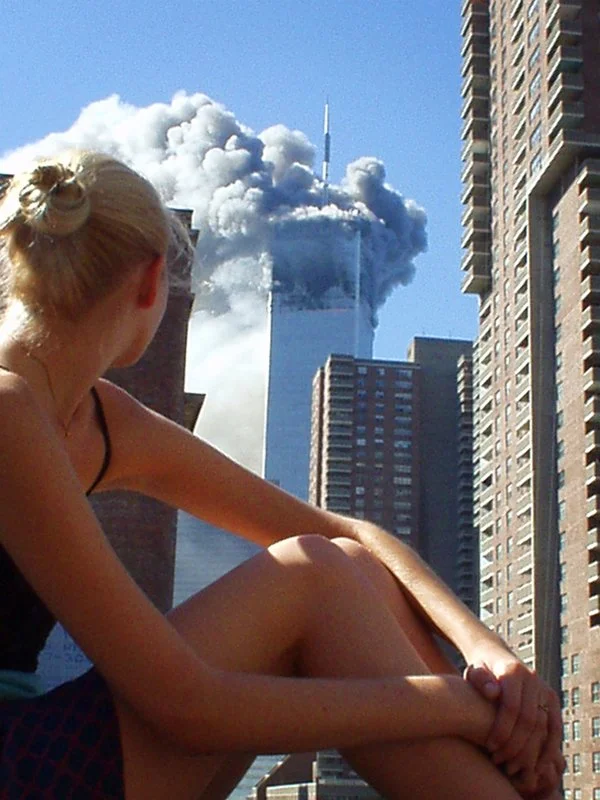
Image Description: Ari Abramczyk’s widely circulated photograph from September 11, 2001, showing Jaqui, a 21-year-old Australian fashion model, seated in the foreground of a Manhattan rooftop and looking back toward the burning World Trade Center. Seen mostly from behind, Jaqui sits with knees drawn up and arms resting across the legs, while one of the Twin Towers rises between surrounding buildings in the distance, engulfed in a vast cloud of smoke. The bright blue sky and sunlit, almost casual composition of the foreground contrast starkly with the catastrophe unfolding behind.
Credit: © Ari Abramczyk
Everyone can remember what they were doing on September 11, 2001. That sentence is the folk version of the flashbulb theory, and it is largely true, and it is also the trap. I was ten years old, in Belo Horizonte, sitting after school hours in an extra mathematics exam I had been made to retake to cover a run of bad grades. I heard other children in the corridor saying that something had happened in the United States, that planes had hit buildings. I did not understand what it was. I finished the exam. I only understood when I was home, in front of the television, watching the same three or four sequences played over and over, the second plane, the collapse, the people running from the cloud, in a loop that felt less like information than like a ritual the whole world had agreed to perform. What I remember most precisely is not the event but the reception of the event: the corridor, the desk, the arithmetic, the walk home, and then the screen. This is exactly what Brown and Kulik meant. The flashbulb does not photograph the fire; it photographs us, at the moment we learn of the fire.
I had, in fact, already been photographed once. Four years earlier, at the end of August 1997, my parents were watching the BBC, which they did sometimes on occasions where the Brazilian media might not have had yet a great level of coverage, when the announcement of Diana's death was cut into the programme as breaking news. I did not speak a word of English then. I could not follow a single sentence. And yet I remember every detail of that newscast: the color of the studio, the presenter's posture, the change in music, the way the footage of the Paris tunnel was shown and then shown again, the way my mother’s hand went to her mouth. A memory formed entirely without language. This, too, is what the theory would predict, and it is why I have always found the flashbulb so uncanny: it is the memory of a feeling of witnessing, encoded through the bodies of the adults around us, before and beneath any capacity to know what we are witnessing. The six-year-old in front of the BBC and the ten-year-old in the maths exam are the same child, being taught by the same mechanism that history is something that arrives on a screen while you are doing something else.
There is, however, an unsettling second finding in the literature, and any honest text about a twenty-fifth anniversary has to carry it. The day after the attacks, Jennifer Talarico and David Rubin at Duke asked students to write down how they had heard the news; when they tested them again over the following months, the students’ flashbulb memories were no more consistent than their ordinary memories of the same week, while their confidence in them stayed high. William Hirst and a large consortium then followed several thousand people for a decade and found the same dissociation: most of the forgetting happened in the first year and then flattened out, but confidence never fell, and inconsistent personal memories, once formed, tended to be repeated rather than corrected. The wrong version became the version. Which means that the sentence ‘everyone remembers what they were doing on September 11’ is true in a way that is also slightly frightening: we remember with absolute certainty, and we are, in the details, often wrong.
Even the President who was in office that day supplied the textbook case. Four months on, George W. Bush told an audience that he had watched the first plane hit the North Tower on a television set moments before walking into the Florida classroom where he was informed of the second: ‘I had seen this plane fly into the first building… I thought it was pilot error.’ He could not have seen it. That footage was not broadcast until the following day. Researchers who later studied the remark read it not as a lie but as the flashbulb doing exactly what flashbulbs do: the video he watched on the 12th got filed together with the memory of the 11th, and by the time he retrieved it, the two mornings had fused into one. Elizabeth Phelps, who has tracked the same cohort of flashbulb memories for a decade and is now preparing a twenty-five-year follow-up of her own, put the general finding in a sentence I have not been able to put down since I heard it: recount your own flashbulb memory and you can be certain you are right, while knowing that the science says you are probably wrong in about four details out of ten.
Hypermnesia is not the opposite of forgetting. It is forgetting wearing the costume of total recall. The veteran labour reporter Bob Hennelly, who was on air in Lower Manhattan that morning and has covered the aftermath for a quarter-century, put the institutional version of this more bluntly on the same broadcast: ‘when you say never forget, they've had amnesia since then’. The city and the citizen, it turns out, suffer from mirror-image disorders. One cannot stop remembering the day; the other could not be made to remember the year that followed it.
I say this not to undermine anyone’s memory but to relocate the question. If the personal flashbulb is unreliable, then the real archive of a catastrophe is not in the individual mind at all. It is in the collective retelling, and it is in the documents.
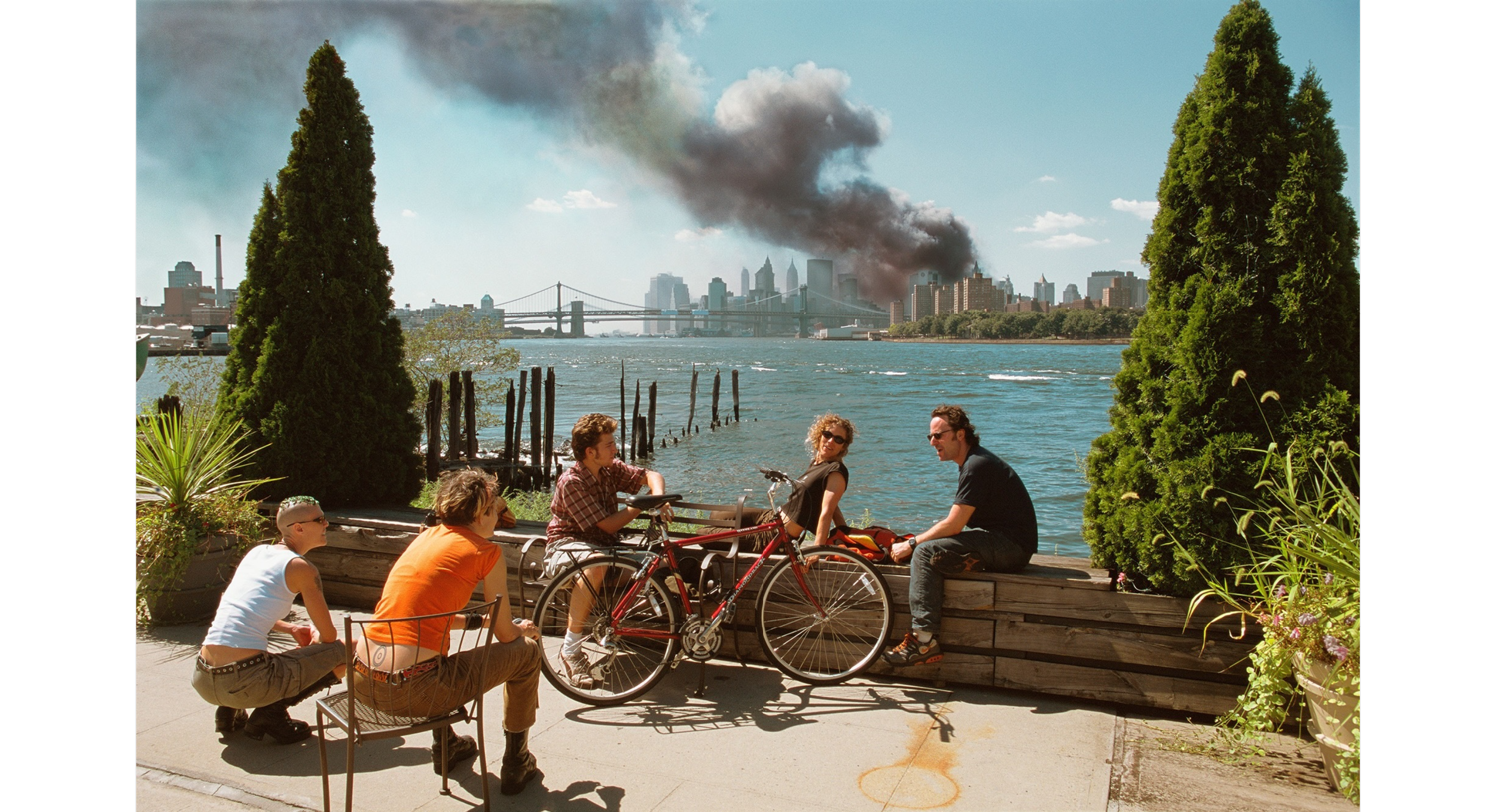
Image Description: German photographer Thomas Hoepker’s color photograph View from Williamsburg, Brooklyn, on Manhattan, 9/11 (2001). Five young people sit and converse beside bicycles on the sunny Brooklyn waterfront, framed by greenery and the blue East River. Across the water, the Manhattan skyline and Williamsburg Bridge are visible as an enormous plume of dark smoke rises from the site of the World Trade Center following the attacks. The apparent calm and sociability of the foreground contrast starkly with the catastrophe unfolding in the distance, a tension that has made the photograph one of the most discussed images of September 11.
Credit: © Thomas Hoepker
I only ever relate to September 11 through other people's retellings. My New York friends who were school-aged then, in schools a few blocks from Ground Zero, tell it the way you would expect: the teachers who did not know what to say, the walk uptown, the dust on the coats, the days off that were not a holiday. What they tell less often is the return. Lila Nordstrom, who was a senior at Stuyvesant High School, the closest school to the towers, said this week on Democracy Now! that the story of her school ‘really most begins on October 9th’, the day the students were brought back to a building three blocks from the site, through five police checkpoints, ‘essentially being paraded in front of television cameras as part of the messaging efforts to show that downtown was safe’, into classrooms with none of the promised filters, next to the barge that carried the debris away every day for months. Her maths teacher requested a transfer almost immediately because of his symptoms, and with him, she said, went her life as a maths student. I have thought about that detail more than I expected to. Two children, one in Belo Horizonte, one on the Hudson, both losing their footing in mathematics in the autumn of 2001, for reasons that could not have been more different and that were, in a sense, the same reason: an event arriving in the room while the arithmetic was still on the board. My former voice teacher, who lived in Queens in 2001, tells it differently: not as a day but as an aftermath, the months in which the city's grief hardened into something they could no longer breathe inside, and which led them, eventually, to leave New York altogether and return to Brazil. I have always thought of that decision as a kind of migration in reverse, a person moving away from the place of the wound because the wound had become the city’s only weather. And I have one memory of my own, of a sort. In 2011 I was living in New York with a former Juilliard graduate in dance and drama, a flatmate of magnificent sarcasm, when my mother called from Brazil one morning to tell me, before I had seen any news, that Osama bin Laden had been taken down. I repeated it aloud. My flatmate, without looking up, delivered a remark so dry and so perfectly timed that I have kept it as my private flashbulb of that day, and which I will not reproduce here, partly out of loyalty and partly because it belongs to the genre of things New Yorkers say to survive their own history. What I noticed, even then, was that the news did not close anything. The city did not exhale. Ten years into the flashbulb, the killing of the man who had planned the attack registered, in the bodies around me, as one more item on a screen while everyone was doing something else.
This is what a quarter-century looks like from the outside: a set of borrowed memories, none of which is the event, all of which are about how the event went on. And it is why Tuesday’s press conference matters to someone like me, who was not there. Because Mamdani’s administration did not stand up to add another retelling. It stood up to change what can be known.
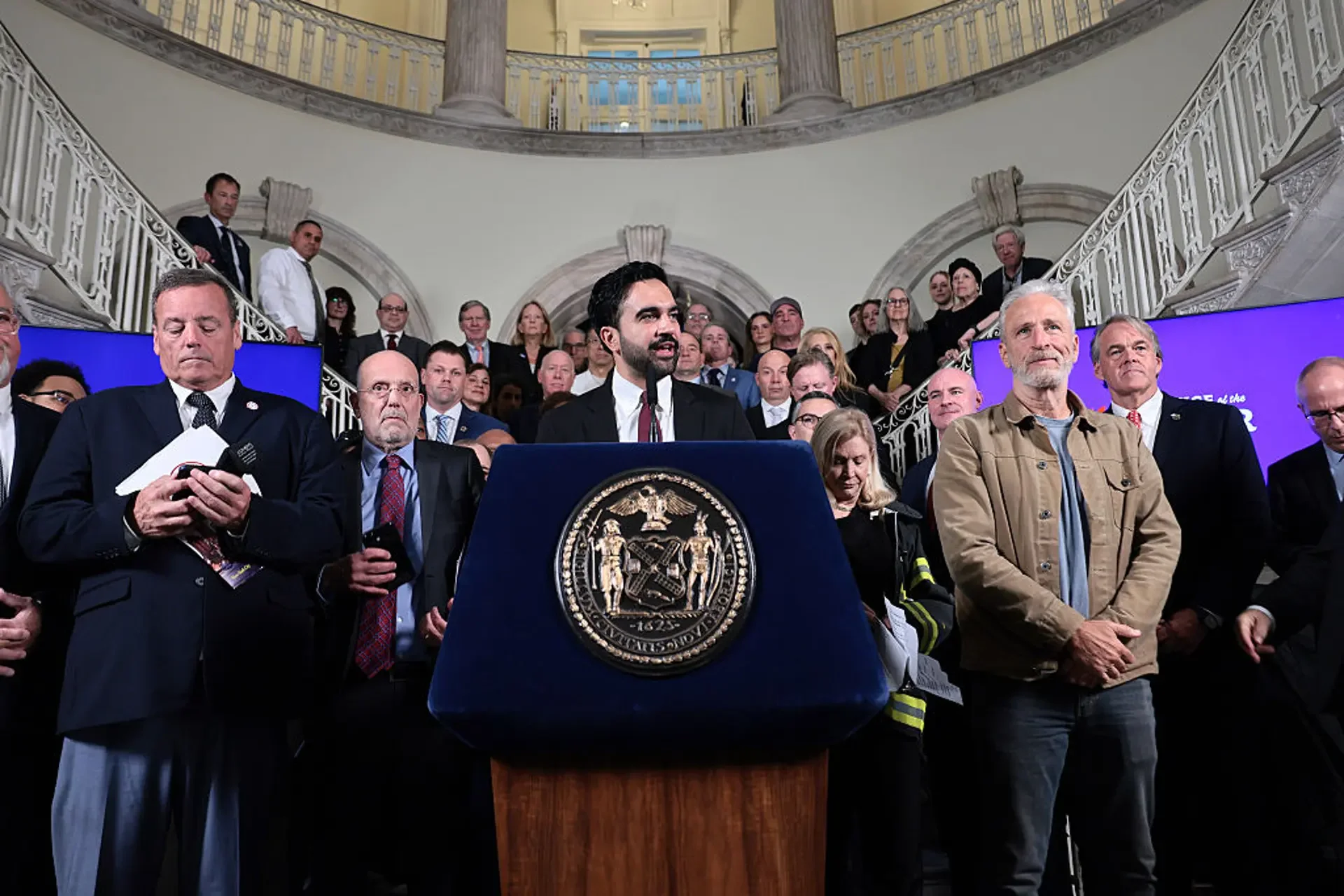
Image Description: New York City Mayor Zohran Mamdani speaks at a podium bearing the city seal during a press conference at City Hall on September 8, 2026, announcing the release of documents related to the September 11 attacks. Mamdani is surrounded by a large group of officials, first responders, advocates, and others gathered across the grand staircase behind him — including comedian Jon Stewart visible at his left and Tom Hart holding a white IUOE Local 94 binder at his right; former U.S. Representative Carolyn Maloney in the FDNY turnout jacket stands directly behind Stewart.
Credit: © Michael M. Santiago/Getty Images
September 8, 2026. Mayor Zohran Mamdani stands at a podium at City Hall in New York, flanked by officials, advocates and survivors. To his left is comedian and writer Jon Stewart, still and dressed in jeans and a jacket. To his right, Tom Hart — a 9/11 first responder who led operating engineers at Ground Zero during the recovery — holds a white binder stamped with a union seal. Nearby, former Congresswoman Carolyn Maloney wears a heavy yellow-and-black FDNY turnout jacket over her own clothes, smiling.
Let me stay with the bodies on that stage for a moment, because I am a performer before I am a theorist, and because the body politic is, before anything else, a set of bodies standing in a particular arrangement in a particular room. Jon Stewart, who has spent the better part of two decades shaming Congress into funding the health of the people who were told the air was safe, gave a powerful speech condemning past city officials for the 25-year-cover-up of toxic air quality. On the opposite side of Steward stood Tom Hart, the operating engineer who led the heavy-equipment crews at Ground Zero during the recovery, holding a custom white binder embossed with the seal of IUOE Local 94, the union whose members ran the cranes and the grapplers on the pile. And somewhere in the frame, former Congresswoman Carolyn Maloney, wearing an FDNY turnout jacket, the same gesture of homage she has made in Washington for years when the fights over the Zadroga Act — the federal law, passed only after a decade of lobbying and named for a police officer who died of a 9/11-related illness, that funds the World Trade Center Health Program and the Victim Compensation Fund — were at their most bitter. What struck me, watching, was the distribution of affect across those three bodies, and how legible it was to anyone trained to read a stage. Maloney was smiling, openly, a smile of rejoicing at a feat she had waited a quarter-century for, and her whole posture in that heavy jacket was lifted, forward, almost girlish. Stewart, beside the Mayor, was somber, weight back, hands still, face closed in a respect that bordered on grief. Hart held the binder the way you hold a thing that has cost lives to assemble. Three registers of the same emotion, held at the same moment, in the same light.
In the theatre we call this attunement, and it is what an ensemble does when it is working: not everyone feeling the same thing, but everyone feeling toward the same thing, from their own place in the score. Stephen Porges, whose Polyvagal Theory I have written about elsewhere on this website, would call it co-regulation, the way nervous systems in proximity settle each other, so that a room full of people who have been fighting a government for twenty-five years can, for the length of a press conference, stop bracing. I think that is what was actually announced on Tuesday, underneath the 170,000 pages. Maloney’s smile and Stewart’s stillness were not two reactions to the news; they were two parts of a single body finally being allowed to exhale, with the state, for once, standing inside the exhalation rather than outside it. The turnout jacket is the most precise detail, because it is a piece of protective clothing worn by someone who does not need protection, on behalf of those who needed it and did not get it. It is costume in the exact theatrical sense: a garment that lets a body carry a meaning it could not otherwise hold.
When Stewart finally spoke, the stillness turned into something else, the deadpan that has always been his instrument for carrying rage without spilling it. ‘I want to be fair to the city,’ he began, and the room, which knew him, waited for the turn. ‘If you look at the Harding memo, they didn't recognise that the air that everyone was breathing in downtown Manhattan was toxic until October of 2001. So, to be fair to them, they only buried that information for twenty-five years.’ And then the line that will, I suspect, outlive the press conference: ‘The city began covering their ass three weeks in’. It is worth noticing what that sentence does in the body of a listener. It converts the abstract noun liability back into a verb with a subject, and it dates it: three weeks, a memo, a title about fiscal responsibility. This is what comedians and dramaturgs have in common with archivists. All three know that the difference between a grievance and a fact is a timestamp.
The next morning, on the same broadcast, John Feal was asked what the release meant to someone like him. Feal is the founder of the FealGood Foundation, an operating engineer who lost part of his foot on the pile and then spent, by his own count, twenty-two years, four hundred trips and 2,400 meetings walking the hallways of Congress. His answer refused the drama the question offered him. ‘There was no smoking gun there,’ he said. ‘There was just smouldering facts that we knew: that the air quality wasn’t safe. We knew we were getting sick. And then science caught up to us and gave us validity.’ What bothered him was arithmetic. Almost ten thousand people have died of a 9/11-related illness since the attacks; 155,000 are enrolled in the World Trade Center Health Program; more than 57,000 of them now carry a certified cancer, one in three. ‘Maybe if they came clean,’ he said, ‘those numbers wouldn't be so staggeringly high’. I want to hold Stewart's sentence and Feal's sentence side by side, because together they describe the exact shape of a hypermnesia that is not a disorder. The survivors did not need the documents to remember. They remembered perfectly; their bodies remembered in cancers. What they needed was for the state’s memory to be made to match theirs. That is what ‘validity’ means in Feal’s mouth: not the confirmation of a suspicion but the closing of a gap between two archives, the one written in cells and the one kept in sixty-eight boxes.
And there is the speech itself, which I have now read several times and which is, as a piece of civic rhetoric, remarkable for what it refuses. It refuses the passive voice. ‘People got sick because the leaders they trusted lied and told them they were safe to breathe in toxic air,’ the Mayor said, and then, of the years that followed, that the government which had not hesitated to send them into harm's way ‘was nowhere to be found’. He closed with Luis Alvarez, the NYPD bomb-squad detective who testified before the House Judiciary Committee in June 2019 the day before his sixty-ninth round of chemotherapy, and who told the members of Congress: ‘You all said you would never forget. Well, I am here to make sure that you don’t.’ Alvarez died less than three weeks later. His brother Phil was on the stage on Tuesday. The Mayor's line that followed is the one I want to hold onto: that never forget must be ‘not just a platitude, but something material’. Material. That is the word a memory disorder cannot supply, and the word an archive can.

Image Description: Aquarius, Piscis Australis & Ballon Aerostatique, plate 26 from Urania’s Mirror (London, 1825), a hand-colored astronomical chart engraved by Sidney Hall. The constellation Aquarius is personified as a muscular, bearded figure crowned with leaves and draped in red cloth, reclining across the heavens while pouring a stream of water from a large golden urn. Stars and their names are superimposed across the figure and surrounding sky, with Piscis Australis represented by a fish below and part of a golden hot-air balloon at lower right. The elaborate mythological imagery transforms the astronomical positions of the stars into a richly illustrated celestial scene.
Credit: Public Domain/Adam Cuerden
Here is where I leave the psychology behind, and I want to be transparent about why. Flashbulb memory theory explains how I remember a corridor in Belo Horizonte. It does not explain why a state chose, in September 2026 rather than September 2006 or 2016, to release the memo it had spent twenty-five years litigating to keep. For that I need a theory of timing, and the only one I have that is large enough is astrological. I am aware of what that costs me with some readers. I ask only that they read the archetype as a lens, not a mechanism, and then decide for themselves whether the lens shows anything.
In the astrological reading of late 2001, the sky was dominated by an opposition between Saturn and Pluto, the two planets that traditional astrology assigns, respectively, to structure and to its destruction. Astrologers had been writing about that opposition for months before it went exact in August 2001, and afterwards it became, for better or worse, the standard occultural shorthand for the attacks: the moment the structure and the underworld faced each other across the sky. Pluto was then in Sagittarius, the sign of belief, of foreign horizons, of the crusade; it stayed there until 2008, through the whole long arc of the wars that the Mayor's earlier anniversary statements used to name. Then, from 2008 to 2024, Pluto moved through Capricorn, the sign of institutions, of the state, of the father, of the record. Those were the years of the two lawsuits, of the sixty-eight boxes sitting undiscovered in a Department of Environmental Protection office, of the Harding memo, of administration after administration choosing, in the Mayor's phrase, to bury the survivors 'in legal arguments and in red tape'. Pluto in Capricorn is the archetype of the state's relationship to its own secrets. It hoards, it litigates, it limits liability. And in November 2024, Pluto entered Aquarius for the first time since the 1790s, where it will remain for roughly the next two decades.
I first saw the archetype applied to this particular mayor in a reel by the psychiatrist and astrologer Judy Tsafrir, posted during the primary campaign in 2025. Her reading was of the two candidates as two Plutos. Cuomo, in her framing, was Pluto in Capricorn: the son of a governor, funded from above, a power that had already shown its shadow in the harassment allegations and in the reported attempt to obtain an accuser’s gynaecological records. Mamdani was Pluto in Aquarius: a young South Asian Muslim immigrant, a democratic socialist, a housing organiser who won on small-dollar donations, embodying, in her words, ‘the power of the collective, mutual care, and society transformed from the ground up.’ I found the reading persuasive in June. After Tuesday, I find it almost too neat. Because what is a public portal, free of charge, with nothing redacted but personal data and live security assessments, with dedicated personnel appointed to help New Yorkers turn the documents into proof of presence for federal compensation, if not the Aquarian gesture in its purest civic form: the secret handed to the many, on the understanding that it belongs to them? Pluto in Aquarius, in righteous leadership, does not destroy the archive. It distributes it.
The generational archetype has, it turns out, a personal echo in Mamdani’s own chart. His reported natal Moon sits in Aquarius, and his Saturn, the planet of structure and the state, sits there too, in the sign of its own rulership, opposite his ascendant and conjunct his descendant, the point astrologers read as significant relationships and open opponents. A Saturn that sits exactly across from the self, in the sign of the collective, is a chart's way of saying that a person's authority will always be tested through, and legitimised by, the group rather than the throne. Whatever one makes of the method, it is difficult not to notice that a mayor whose own Saturn already speaks Aquarius stood up this week and performed, almost to the letter, the Saturn task of an age still governed by that sign: he took a structure that had spent a quarter-century protecting itself, and made it answer to the public instead.
The astrologer Denise Siegel, reading the transits before the election, said she had never doubted Mamdani would win, because Pluto’s transit through Aquarius already carried, in her words, ‘the awakening of people to this reality that the old guard doesn’t have our backs’, and that Mamdani was only ‘the beginning’ of it. She draws the generational contrast I have been drawing here through a different pair of coordinates: not Aquarius against Capricorn, as in Tsafrir's reading, but Aquarius against Leo, the sign in which Donald Trump's own Pluto sits. A Pluto-in-Leo generation, in her account, was tasked with expanding the rights of the self — civil rights, feminism, personal creative freedom — before curdling, in some of its members, into simple self-interest. A Pluto-in-Aquarius generation inherits the opposite assignment: to find its power only through the collective, the group, the 'we' rather than the ‘I’. Two astrologers, two different zodiacal grammars, and they arrive at the same noun for what a portal of 170,000 pages actually is: transparency, handed to the many because it was never the state's alone to keep.
I should say plainly that this is not a text about Zohran Mamdani. He is thirty-four years old and has been Mayor for nine months; the archetype is larger than any one office-holder and will outlast him. What interests me is the fit between a moment and a gesture. The anniversary is a Saturn number, near enough: twenty-five years is not quite one full cycle of the planet of structure, but it is the length of time a wound takes to become an institution. And it is precisely at the moment when the archive's own planet has changed signs that the archive opened. An astrologer would say the sky permitted it. A historian would say the coalition was finally in place. A cultural theorist, which is what I am on the days I am not singing, would say those are two descriptions of the same event, and that the second cannot explain why the first felt inevitable to so many people in the room.
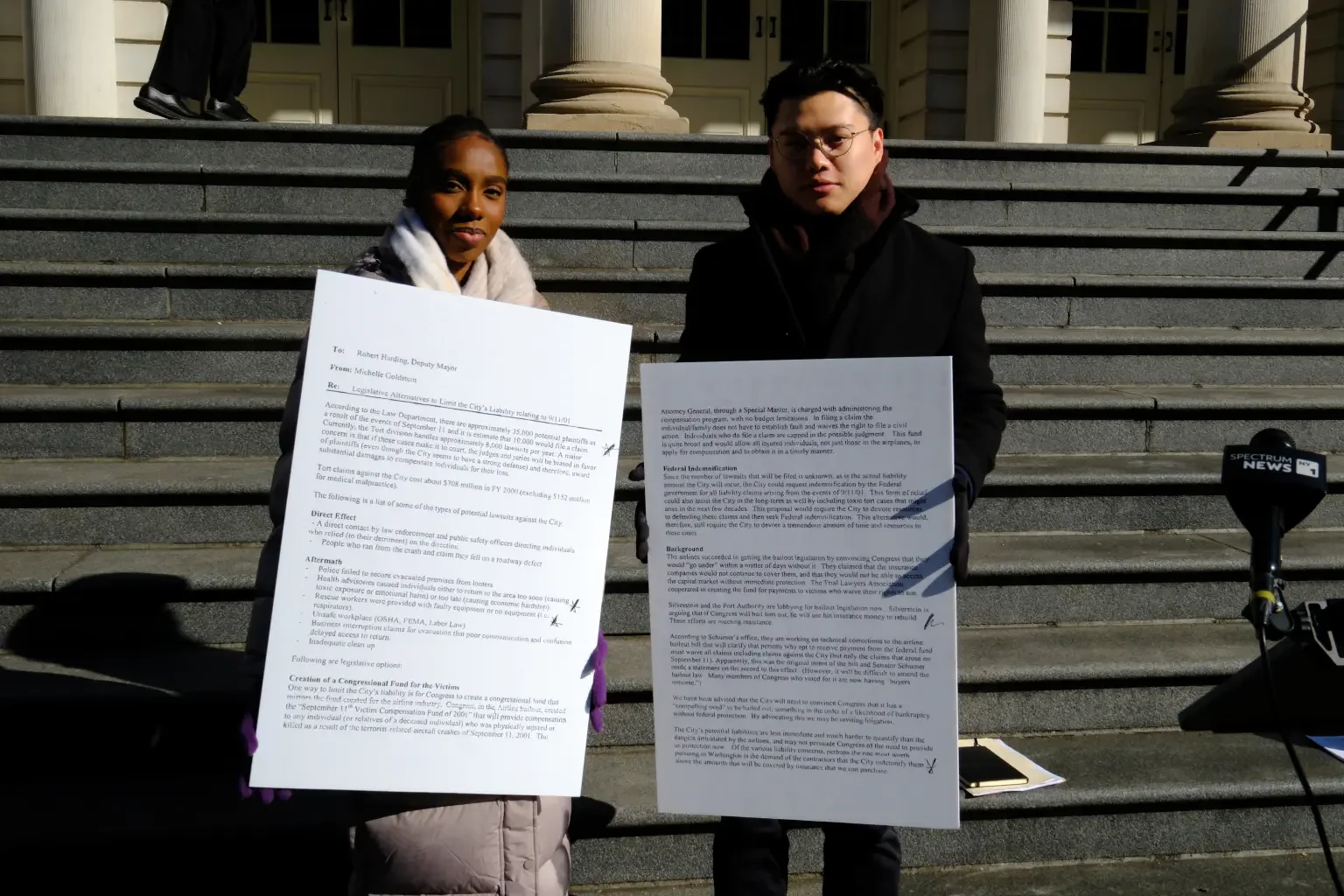
Image Description: Two New York City Council aides stand on the steps of City Hall holding enlarged copies of the so-called “Harding Memo.” Written in the immediate aftermath of the September 11 attacks, the memo warned city officials of potential respiratory and other health risks associated with contaminants at Ground Zero, including metals and asbestos. The aides display the documents toward the press, with a news microphone visible at the right of the photograph.
Credit: © Luiz C. Ribeiro for NY Post
There is a spiritual dimension I have kept for last, because it is the one I trust least in public and the one I believe most in private. In the Afro-Brazilian traditions I practise and study, the dead who have not been properly accounted for do not rest; they remain, in the language of Umbanda, eguns without passage, and the work of the living is not to forget them faster but to count them, to speak their names, to give the wound a form that can be carried. Sara Nelson, the president of the flight attendants' union, who had flown on United 175 the week before it was driven into the South Tower, does exactly this without any cosmology at all. ‘I know the exact moment that my friends die,’ she said, ‘and I say their names every day. Amy, Michael, Amy, Kathryn, Al, Alicia, Marianne, Jesus, and Robert’. That sentence, spoken twenty-five years on, in the present tense, is the most precise description of a working rite I have heard from anyone this week. The Mayor’s sentence that more people have now died of 9/11-related illness than died on the day itself is, in that cosmology, not a statistic but an accusation: the count was never finished, because the state withheld the documents that would have let it be finished. What happened on Tuesday was, in this sense, a rite. 170,000 pages is a very long prayer. The dedicated personnel at DCAS and the public schools, helping people prove they were in the exposure zone, are the ritual specialists of a secular city, and their job is the oldest one there is: to say, with paper, you were there, it was real, we know. Feal, who has no reason to speak my cosmology, spoke it anyway when the anchor asked him where he goes from here. ‘Friday is the one day out of the year I will not advocate,’ he said. It is a day to remember the innocent lives lost to senseless violence, the heroes who ran into harm's way and never went home, the sick and the dying. ‘It's a day where we put aside our ideologies, our differences, our politics, our religions, and we show each other that we're human beings before anything else. Anything short of that, you failed’. A man who has made four hundred trips to Washington keeps one day free of the fight. That is not a pause in the rite. It is the rite.
That is why I could not keep this essay inside the flashbulb. A flashbulb is a memory that photographs the witness and forgets the fire. What New York did this week was the reverse. It turned the light away from us, from our corridors and our maths exams and our BBC evenings, and pointed it, for once, at the fire itself, and at the people who were told to breathe it. The certainty we all carry about where we were will go on being, in its details, slightly wrong. The documents will not. That is the difference between hypermnesia and history.
And so I want to end in the cadence of a country that once signed off its evenings with a promise, Edward R. Murrow's good night, and good luck, a phrase that belonged to an age of gatekeepers and single channels, of Pluto in Capricorn, when the news was something a trusted voice gave you before you slept. That age is over, and the Mayor's speech is one of its obituaries. The sign Pluto now occupies does not sign off at night; it signs on in the morning, in the plural. So here is my version, offered to the survivors, the responders, the families, the union engineer with his white binder, the Congresswoman in her borrowed jacket, the comedian who could not smile, and to the ten-year-old at the maths desk who is still, somewhere, trying to understand what the children in the corridor were saying:
Good morning, and good company. The records are open. Breathe.
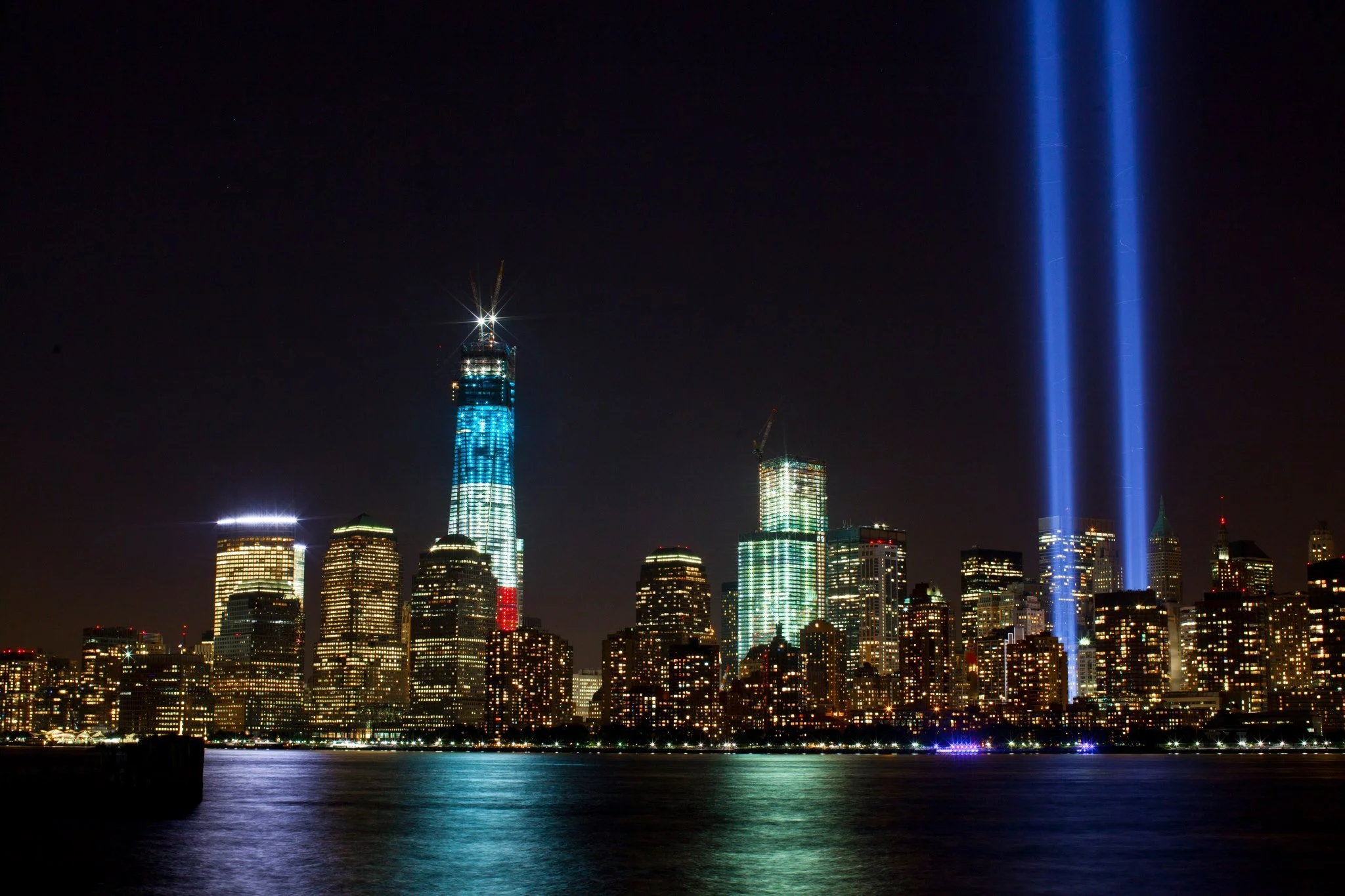
Image Description: Tribute in Light and One World Trade Center (2012). A nighttime view of Lower Manhattan from across the Hudson River, with the illuminated city skyline reflected on the dark water. One World Trade Center, still under construction, rises prominently among the surrounding buildings, while two immense vertical beams of blue light — the annual Tribute in Light memorial — ascend into the night sky from near the former site of the Twin Towers, symbolically tracing their presence in the skyline.
Credit: © Anthony Quintano
Sources and further reading:
1. Roger Brown & James Kulik, 'Flashbulb memories', Cognition 5 (1977).
2. Jennifer Talarico & David Rubin, ‘Confidence, not consistency, characterizes flashbulb memories’, Psychological Science 14 (2003).
3. William Hirst et al., ‘A ten-year follow-up of a study of memory for the attack of September 11, 2001’, Journal of Experimental Psychology: General 144 (2015).
4. BBC, on flashbulb memory and the Bush misremembering, September 2026: youtu.be/lX_kUIu745Y.
5. City of New York, press release and portal, 8 September 2026: nyc.gov.
6. amNewYork, on Jon Stewart's remarks at the press conference: amny.com.
7. Democracy Now!, interviews with 9/11 Health Watch, Lila Nordstrom, Sara Nelson and Bob Hennelly, 8–9 September 2026: democracynow.org and youtu.be/DzrR0AlU-1Y.
8. CBS News, interview with John Feal, 9 September 2026: youtu.be/cjG6lUS5u_g
9. Judy Tsafrir, 'Pluto in Aquarius / Pluto in Capricorn', Instagram, 2025: link
10. CHANI, ‘The astrology of Zohran Mamdani, everyone’s favorite democratic socialist’: chani.com.
11. Denise Siegel, 'Pluto in Aquarius, Mamdani, and coming...', Substack: denisesiegel.substack.com.
12. Stephen Porges, The Polyvagal Theory (2011), discussed in my earlier post on this site.
Photo credit: © Thomas Hoepker