
To Stand By What You Sing About
The Politics of Performance
A stadium tour fell apart this month over two words said on a stage, and by the time it was done, a punk frontman, a UN special rapporteur, and a stand-up comedian had all, in their own registers, said the same thing about what a musician owes an audience.
I left most of social media in 2025, after deleting my Facebook and deactivating my Instagram into what I hope to be a lifetime of freedom (but, you know, artists apparently are indebted to Instagram for having a career, or so I’m told — not my experience). This past week my YouTube algorithm, however, was exploding with the Ed Sheeran-Macklemore debacle and how it generated widespread debate about support for Palestinians and vocal criticism about Israel, so it felt almost impossible not to write about it. I say this after Berlin’s intense state elections campaign, which had BSW — Bündnis Sahra Wagenknecht, a left-conservative German party founded in 2023 by former Die Linke figure Sahra Wagenknecht, combining economically left positions with a more restrictive line on migration and open skepticism of NATO and EU consensus on Ukraine and Gaza — hopefuls placing signs all over Berlin that read: ‘criticism of Israel is not anti-Semitism.’
The timeline, for anyone whose algorithm was gentler than mine: on 4 and 5 September, opening for Ed Sheeran at MetLife Stadium in New Jersey on the North American leg of his Loop tour, Macklemore told the crowd ‘Free Palestine’ and said Palestinians were not forgotten. Within days, Sheeran’s promoter, Messina Touring Group, announced Macklemore was off the remaining dates, citing venues that had threatened to cancel the shows outright. Sheeran, in a long Instagram statement, said the call was not his, that he had spent days on the phone trying to ‘build bridges’, and that among the people he had spoken with was Robert Kraft — the New England Patriots owner whose Kraft Group owns Gillette Stadium, and who, per Macklemore’s own account, had told Sheeran he’d rallied other stadium owners behind an ultimatum. Macklemore responded by pledging a million dollars to Palestinian aid groups and daring Kraft to match it; Kraft’s camp countered that it was in fact Sheeran who had asked him to commit two million to the same cause. Somewhere in the exchange, the actual argument — whether an artist may say ‘Free Palestine’ from a stage they have been invited onto — got lost, and has not, as far as I can tell, been found again by either side.
What happened next is the part that made this more than a booking dispute. Within a day of Sheeran’s statement, all four of his remaining supporting acts — Finneas, Lukas Graham, the Irish singer-songwriter Aaron Rowe, and the traditional Irish band Beoga, who had been playing inside Sheeran’s own set each night on his loop-pedal segment — announced they were leaving the tour too. Finneas wrote that ‘artists must not be silenced when they speak up for the oppressed.’ Lukas Graham’s note was the plainest: nobody’s bank balance, he wrote, should decide whose suffering gets acknowledged. A pop headliner had, in the space of about seventy-two hours, lost his entire supporting bill — not to a rival promoter, not to scheduling conflicts, but to solidarity.
By the middle of that week, NBC News had already named the mechanism plainly: what's known as the Streisand effect — the attempt to suppress something backfiring by making it far more visible than it would otherwise have been — had left Macklemore with, in the outlet’s own phrase, an even bigger platform than before, while Sheeran was the one absorbing the fallout. It is worth sitting with the irony of that for a second, because it is not really an irony at all — it is the oldest lesson about power and attention there is, and one every publicist, censor and stadium owner keeps having to relearn: the fastest way to make millions of people say a phrase out loud is to tell one person they may not say it. Macklemore's Instagram following grew. His donation pledge made headlines his original stage comments never would have on their own. The four openers who walked turned a booking decision into a story about the tour itself. Kraft, trying to make a controversy disappear from a stage, had instead put it on every stage, timeline and late-night monologue within reach. Nobody involved in silencing Macklemore appears to have asked what happens to a sentence once you spend a week publicly explaining why it could not be said.
It is Ken Casey of the Dropkick Murphys, though, who gave the episode its sharpest sentence, and the one I have borrowed for the title of this text. Speaking to Boston Public Radio the following week, Casey — thirty years into a career built on exactly the kind of loyalty a tour is supposed to run on — said that when you choose the acts who open for you, 'that's brotherhood, sisterhood, that's family. You live or die with the people you bring on the road.' And then the line that got the studio audience applauding: Sheeran, he said, had 'took the knee', and 'that's not how Dropkick Murphys would operate.' Casey did not stop at loyalty. He went further, into the actual claim a performer makes when they get on a stage at all: 'all the artists that I loved as a kid, no matter what it was like, they stand by what they sing about. Once you let that go, then you don't have any worth in your music.' He offered his own receipt for the cost of that principle — a Rocklahoma set where he estimated half the crowd walked out after Dropkick Murphys said their piece, and where he was told, politely, not to expect a rebooking.
I want to sit with that phrase for a moment, because it names something I recognise from the inside of a career that has spent twenty-five years moving between opera houses, cabaret stages and cruise-ship lounges, and it is this: a tour roster is not a spreadsheet of interchangeable acts. It is, in the older and more theatrical sense of the word, a company. When you put your name next to someone else's on a bill, you are making a small, temporary, but real claim about the kind of room you are building together. Sheeran did not fire Macklemore for missing a cue or blowing a note. He let him go for the content of what he sang — or, more precisely, said — about the thing he actually cares about, which is the substance a song is supposed to have underneath the melody. A performer who will trade that substance away the moment a stadium owner objects has not been neutral. He has simply let someone else choose, on his behalf, what his art is allowed to mean.
This is, of course, not only a music-industry story, and it did not stay one. The week the tour collapsed was also the week the UK announced its own sanctions on West Bank settlement goods, and on the Unapologetic podcast, the UN Special Rapporteur on the Occupied Palestinian Territories, Francesca Albanese, was asked directly about the Sheeran-Macklemore affair in that context. Her answer folded the pop-culture episode into what she called, more than once in the conversation, the Palestine effect: the sense that the war has, in her account, revealed a reality people can no longer look away from, so that a stadium owner leaning on a headliner and a government announcing settlement sanctions become, in her framing, two expressions of the same pressure finding two very different valves. Of the rapper's stand itself, and the backlash that met it, she was unambiguous, calling it simply so human, so normal, so ordinary — the sound, she implied, of someone refusing to be the exception to their own convictions the moment convictions become expensive.
I do not bring her in to lend the essay a political authority it would not otherwise have. I bring her in because she was, that week, doing in a policy register exactly what Casey was doing in a green-room register: insisting that solidarity is not a costume you can take off when the room turns hostile. It is worth noticing how rarely, in this story, that insistence came from the most powerful person in it. It came from a punk frontman losing half a festival crowd, from a UN rapporteur who has herself been sanctioned by Washington for her findings, from four supporting acts who had far more to lose from a cancelled arena tour than Ed Sheeran did.
And then, because nothing in 2026 stays serious for very long, it became a bit. Within days, the comedian Gianmarco Soresi — a New York stand-up who has built a career out of turning the week's news into crowd work — was doing material about it to laughter and applause: Macklemore, he offered, was 'my second favourite rapper, of course, after Lin-Manuel Miranda'; he was 'boycotting Ed Sheeran's music unless I need something at Starbucks'; and, landing the joke that outlived the set itself and got quoted in entertainment write-ups on its own, that if Sheeran was feeling stressed, 'I'm sure his friend Robert Kraft could give him a hand with some spa recommendations.' Other comedians picked the story up within days of each other, in the way a story only travels once it has stopped being merely political and become, also, legible — a stadium tour that a comedy audience could follow beat for beat, punchline for punchline, without anyone needing to explain who Robert Kraft was.
The satire did not stay in the USA, either. Days later, Saturday Night Live UK aired a sketch that widened the target: a fictional King Charles, meeting AI executives, unveils an assistant modelled on Princess Diana — a jab at Earl Spencer's freshly published tell-all Swan Song — before the segment pivots to Sheeran himself, wandering in “sitting on the fence”, refusing to pick a side in the sketch’s own fictional robot uprising, and breaking into a deliberately vapid ballad about seeing only grey between black and white. It is a cheap joke and a precise one: the show never needed to say Macklemore’s name for the audience to know exactly which real refusal to take a side it was singing about. By the following week, Sheeran’s neutrality was not only costing him tour partners and prompting a tearful walk-back in Philadelphia — it had become shorthand, on primetime British television, for the very concept of refusing to choose.
It is worth being honest, too, about the story’s less legible afterlife. Once the tour fell apart, some of the internet’s amateur investigators went looking for the money behind it, and found real, documented things — Kraft’s seat, years ago, on the conflicts committee of a firm whose then-CEO was later found to have paid Jeffrey Epstein tens of millions of dollars for estate work, or a promotions contest run by a chain part-owned by funds connected to that same firm — and then, in the way these threads do, strung them into a shape that implied far more than the documents themselves support. I have looked at some of that material. I am not going to repeat its conclusions here, because I have not verified them and because the distance between ‘sat on a board with’ and ‘was complicit in’ is exactly the distance a responsible essay is supposed to protect. But its very existence is its own small proof of the argument I am making: within a fortnight of two words spoken on a stage in New Jersey, people were tracing the ownership structure of a guitar chain to work out who, ultimately, gets to decide what an artist is allowed to say. That is not proportion. That is what it looks like when a culture, rightly or wrongly, has stopped believing that power explains itself honestly the first time it is asked.
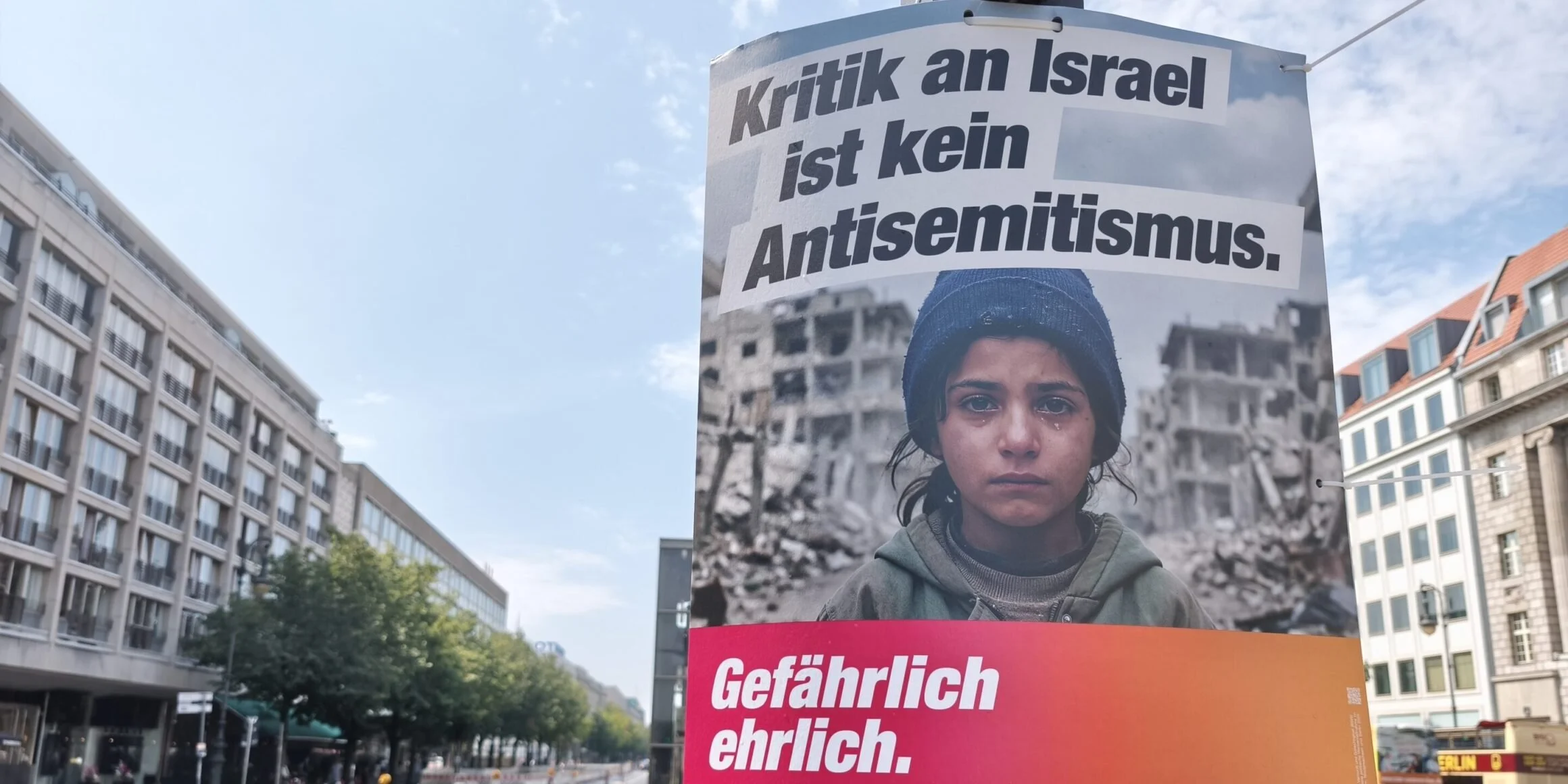
Image Description: A BSW (Bündnis Sahra Wagenknecht) election poster displayed on Unter den Linden in central Berlin. The poster shows a tearful child standing before heavily damaged buildings, accompanied by the statement “Kritik an Israel ist kein Antisemitismus.” (“Criticism of Israel is not antisemitism.”). A red-to-orange panel below carries the slogan “Gefährlich ehrlich.” (“Dangerously honest.”). The poster stands prominently against the broad avenue, surrounding buildings, and blue Berlin sky.
Credit: © Imanuel Marcus
Which brings me back to the signs I kept walking past this summer, blue and white on Berlin lamp posts, insisting on a distinction — criticism of Israel is not anti-Semitism — that a stadium owner in New Jersey and a promoter’s legal department clearly did not share. I do not think Robert Kraft or Ed Sheeran read those signs. But they were, without knowing it, answering the exact question the signs posed, and answering it in the negative: that in the rooms where tours get booked and stages get built, a sentence about Palestinian children can still be treated as indistinguishable from an attack on Jewish people, and can still cost a rapper his stage and, for three days in September, cost a headliner his entire supporting bill. Casey’s phrase was written for a much smaller stage than this one — a green room, a festival lot, a punk band’s idea of family. But it scales. A politician who runs on a slogan and abandons it the moment it costs a coalition partner has, in Casey’s terms, taken the knee too. So has a newspaper, a university, a government. The politics of performance, it turns out, is not a metaphor invented for musicians. Musicians simply make the transaction visible, eight thousand people at a time, under lights that do not let you look away from who just left the stage and why.
Stand by what you sing about, or don’t sing it.
Image Description: An empty concert stage illuminated in cool blue light and enveloped in thick, swirling theatrical smoke. Several microphone stands, keyboards, electronic equipment, and drums are arranged across the stage, with cables running along the floor and two water bottles near the front. No performers are present, giving the scene an atmospheric sense of anticipation—as though the stage is waiting for the performance to begin.
Credit: © Magnus Lunay
Sources and further reading:
Sheeran's promoter and Sheeran's own statement, and the timeline of Macklemore's removal: reported by Rolling Stone, Deadline, and NPR, September 2026.
Finneas, Lukas Graham, Aaron Rowe and Beoga's withdrawal statements: Rolling Stone, NPR.
Doha Madani, 'Macklemore has an even bigger platform after being dropped from tour as Ed Sheeran suffers the fallout', NBC News, 16 September 2026: nbcnews.com.
Ken Casey (Dropkick Murphys), interview on Boston Public Radio: Rolling Stone.
Kraft/Sheeran donation exchange and Kraft's statement: Rolling Stone, September 2026.
Guardian, ‘Ed Sheeran’s Loop tour and the culture war over Israel-Palestine’, 19 September 2026: theguardian.com.
Francesca Albanese, interview on Unapologetic with Middle East Eye, September 2026.
Gianmarco Soresi, stand-up material on the Sheeran-Macklemore affair, September 2026.
CNN, ‘Acts abandon Ed Sheeran tour after Macklemore barred over "Free Palestine" comments’, September 2026: cnn.com.
Ed Sheeran’s remarks at Lincoln Financial Field, Philadelphia, 19 September 2026: reported by ABC News, NBC News, Mediaite, and Middle East Eye.
Photo credit: © WireImage via Getty Images