
Jasmin Kosubek, Benedikt Zeitner and the therapeutic voice of the German right
How a former RT presenter and a Berlin Heilpraktiker, friends since a Daniele Ganser lecture, built a podcast where the language of trauma and healing does the work of normalizing the far right, and why ‘honesty’ is not the same thing as truth.
In the autumn of 2026, Benedikt Zeitner went looking for his ancestors and asked ChatGPT to help. He had just come back from a retreat with the trauma teacher Thomas Hübl, he told the viewers of Ganz ehrlich, the podcast he has hosted with Jasmin Kosubek since July. On the retreat, he said, about 220 people sat in a room and turned their attention to a ‘collective theme’ named ‘Flucht und Vertreibung’, flight and expulsion. At first he felt nothing, then a shutdown, then a sadness that seemed to belong to someone else. So he asked the chatbot what his forebears might have lived through, and the machine ‘spat out’ a name: a great-grandfather, a pastor among German settlers in what is now Ukraine, whose family was driven out in 1918.
I don’t want to make fun of a person who felt his ancestors for the first time. Nobody’s grief deserves mockery. I tell this story because that one episode lays out the whole program. History arrives as a feeling. The feeling is checked against a chatbot. Then the feeling turns into politics. A few minutes later, Zeitner recalls his co-host, German journalist and former RT Deutsch presenter Jasmin Kosubek, shrugging at a Holocaust film and draws a conclusion: this ‘disconnection’ is ‘exactly the attitude of those who … vote AfD a lot’, the people who want history ‘to rest’. Not long after that, Kosubek explains to him why one accusation, as she sees it, ‘can't be made against the AfD’: antisemitism.
In my essay for Philosophie Magazin I argued that the right has stolen the favorite gesture of critique. Genealogy is the move that shows how something presented as natural was in fact made, and it now survives in neglected form as “do your own research”. Ganz ehrlich shows the second theft that came with the first. The language of healing, the slow and serious work of listening to wounds, has been turned into a mood. In that mood, every political position is a symptom, every symptom deserves compassion, and the compassion flows mostly one way.
Full disclosure: I met Benedikt Zeitner twice, once on an afternoon by the water in Berlin in the summer of 2025. Since then I have been researching his public work and the 1939 law that makes it possible, the Heilpraktikergesetz (HeilprG), and that research appears soon in The Skeptic, thanks to Michael Marshall. Everything below comes from material that Zeitner and Kosubek have published themselves.
I. The guest list at the Babylon
Their friendship has an origin story, and they tell it with pride. In the January 2026 livestream that previewed the podcast, Kosubek introduces Zeitner as 'the therapist who can change your life' and says they met 'eleven years ago at an event hosted by Dr. Daniele Ganser in Berlin'. In the first episode of Ganz ehrlich, Zeitner gives the details. He had gotten to know Ganser by email, he says, because he ‘knew lots of his videos about September 11 from YouTube’. He invited Ganser onto his cabaret show in Basel, they went for drinks afterwards, and the two still meet ‘about once a year’ when Ganser is in Berlin. Zeitner and Kosubek were both on the guest list for Ganser’s lecture at Kino Babylon. He recognized her ‘from RT Deutsch’ and, as he puts it, had ‘the standard prejudices … that you’re Putin’s niece’.
The audience is meant to laugh at that joke, and the joke tells you something. The question it raises, what it means to spend seven years as a leading face of Russian state broadcasting in Germany, is waved away before anyone can ask it. Kosubek joined RT Deutsch at its launch in 2014. Correctiv described her as the channel’s flagship presenter, and its account of her 2016 interview with Frauke Petry reads like a list of cues offered to the AfD leader rather than questions. In June 2026, Belltower.News reported that she herself acknowledges RT followed ‘eine russische Linie’ (a Russian line) in foreign policy.
I hold a less common view on RT than most of her critics. Working there is not, on its own, an indictment. In March 2014, US-American journalist Abby Martin used her own RT America show to condemn Russia’s military intervention in Crimea on air, live. The question is never who signed your paycheck. It is what you did when the line ran through you. In October 2026, Kosubek talked about her own appearance on German journalist and lawyer Melanie Amann’s podcast, where Amann had asked her whether there is press freedom in Russia. Zeitner, to his credit, asked why she couldn’t simply say no. She answered that Russians have ‘other values’ and that 'for their circumstances, there is such a thing as press freedom'. She then added that she would no longer say so today, since many journalists have left. That was twelve years after Martin’s broadcast, four years into the full-scale war, and the answer was still ‘for their circumstances’.
Ganser is not incidental to this friendship. He is the reference point for its moral judgements. On the podcast he is invoked for his idea of a ‘Menschheitsfamilie’, the family of humankind. In the same first episode, Zeitner uses that idea to separate people who ‘really fight against our culture’ from ‘the “we” of Europe or the “we” of Germany’. Kosubek explains why she once sent Melanie Amann to Ganser on Ukraine by pointing to how people come out of his talks: 'peaceful people who carry peace into the world'. Amann’s audience and Markus Lanz’s, by contrast, come away feeling anything but peaceful. Truth is not the test here. The test is the emotional temperature of the audience. A therapeutic culture can live with that, but a public sphere can’t.
The family of humankind, then, has a border, and I have stood at it. On the afternoon by the lake in the summer of 2025, I played a few seconds of the Brazilian song ‘Vulva Diva’ by Wealstarcks on my phone. Zeitner immediately asked me to turn it off. As I remember his words, it was something like ‘kannst du bitte keine laute Musik spielen, niemand spielt Musik hier’: could you please not play loud music, nobody is playing music here. It lasted a few seconds. I know that asking someone to lower the volume is, on its own, an ordinary request, and that is exactly why it stayed with me. What he heard was not the volume. It was a Brazilian, erotic, unruly sound arriving uninvited on a German summer afternoon. The man who tells the cameras that we should listen to each other and meet every feeling with curiosity did not get curious. He set a house rule, and every ‘we’ begins with a house rule. Audre Lorde wrote of the erotic as a source of knowledge that an orderly world learns to fear. Pombagira, the spiritual entity I have spent years writing about, has always known that her music and expression is the first thing to be called “noise”.
That afternoon, Zeitner also told me that years earlier he had traveled to Brazil to watch João de Deus at work, the celebrated “healer” of Abadiânia, since convicted of sexually abusing women who came to him for help. He went, he said, to witness. What a future trauma therapist takes away from watching a man stage miracles for the desperate, I can’t say. But it is an education.
II. 2022: ‘my secret agenda’
The template was in place four years before the podcast. In their first recorded conversation, published on Kosubek's channel in June 2022, the stated topic is ‘trauma and conspiracy theories’. Kosubek introduces Zeitner as a Heilpraktiker and trauma therapist who works with the NARM model, a former opera student and music cabaret artist. She also says that she has been to see him in a professional capacity ‘a handful of times’ and has 'already sent many people to you'. So the host, the guest’s former client and the guest’s referral network are the same person, and the audience is not told this as a conflict of interest. It is told as a recommendation.
Zeitner then sets out his position. The term “conspiracy theory”, he says, is a 'Kampfbegriff', a combat term, and history shows it exists to keep certain critical ideas from being admitted at all. Later he goes further: ‘I'm a big fan of it, I have the secret agenda of normalizing this term’. Then the examples arrive. Ganser has shown, he says, that 'almost all wars are based on lies'. The ‘official theory of September 11‘ — nineteen hijackers with box cutters defeating ‘the biggest and safest air-defense system in the world’ — is, in his words, itself a conspiracy theory. He compares normalizing the label to the gay movement of the 1970s reclaiming the word “schwul” — the former German slur for a gay man. He does add that a large share of conspiracy theories are ‘absolute nonsense’, and fairness requires me to report that. But the genealogical move has been made. A category that once marked a boundary of evidence is turned into an identity that people are invited to wear with pride.
The same conversation covers vaccination. Zeitner says that 'we can't really trust' the available data and that vaccine side effects are ‘swept under the carpet’. He illustrates the trauma lens with anonymized clients: one whose childhood house arrest made lockdown unbearable, another who tried in vain to talk everyone around her out of getting vaccinated. When Kosubek asks about the scientific basis of therapeutic methods, he answers that it 'doesn't interest me that much, because much of what really changed my life was not scientifically supported'.
That sentence is the core of this essay, so I’ll say plainly why. Everyone is entitled to that sentence as a description of their own life. But a person who offers psychotherapy to paying clients under a Heilpraktiker license is not speaking only about his own life. Germany’s 1939 Heilpraktikergesetz makes this situation possible, and I have written about it elsewhere. What concerns me here is the political use of the stance. Once science is optional and “conspiracy theory” is a badge of honor, the only test left for a claim is whether it feels true to someone who has done enough inner work.
III. ‘Giving them space’
Belltower.News's critique of Kosubek is that her long-form format normalizes the far right through warmth and an appearance of openness. I didn’t need to argue that. She described the method herself. Preparing an interview in September 2026, she told Zeitner she did not want to 'do a Melanie Amann interview'. With ‘Nazis’, she said, she does not want to fall back on the usual approach, ‘but really give them the space to let them explain’.
The guest list shows what that space contains. At the end of the January 2026 livestream, Kosubek announces that Götz Kubitschek, the publisher of the New Right, will sit at the same table the following week. Zeitner remarks that this is ‘one of the moments where I don't agree with Jasmin’. That is his only objection, and it is followed by laughter. In the same livestream, Kosubek says she is ‘read as left-liberal’, and that people are therefore surprised she reads books like Martin Sellner's Remigration and 'has him on my channel', and that she tends to have ‘rather right-wing outgrowths on the subject of migration’.
By October 2026 she calls that same book 'a manual for fascism'. Her reason is that it describes which pedestrian zones are “German enough” and implies an institution that would enforce assimilation. I’d quote that verdict in full anywhere. Then she tells how she confronted Sellner with those passages and how he answered with a joke: 'the Brazilian churrasco won't be banned'. Her response is 'and maybe that's true. Maybe he means it that way'.
I am Brazilian. I have lived in Berlin for almost a decade, and I have watched the word “Remigration” move from the margins to the parliaments. I know what it means to hear a man who wants to decide who is ‘assimilated enough’ promise that my barbecue is safe. It is the oldest courtesy of exclusion, which spares the food and lets the person go. Kosubek, to her credit, says she isn’t sure ‘that makes it better’. But she wants him back — 'I've often thought about whether I'll do another interview' — because ‘most people don't want to talk to Martin Sellner’, which is ‘a shame’. In the same episode she mentions that the new Institut für Remigration in Magdeburg reaches her because 'I'm apparently on their newsletter'.
In the first episode of Ganz ehrlich, Kosubek describes a gala she attended ‘on Friday evening’ at Berlin’s Westhafen. This was the first 'Sovereign Nations Summit' of Europe of Sovereign Nations (ESN), held on June 26, 2026. ESN is the European party whose parliamentary group the AfD’s René Aust co-chairs, and that evening’s speakers included Bulgaria’s Kostadin Kostadinov, Slovakia’s Milan Uhrík and France’s Éric Zemmour. In Kosubek’s words it was 'in plain language, European nationalists. I have no problem with that'. She praises ‘a beautiful gala, a great event’ and ‘really nice people … from the Junge Freiheit’, the Berlin weekly widely regarded as the flagship paper of Germany’s New Right, and then adds: 'I also have no problem with elements of remigration'. In fairness, she also says she ‘can no longer bear’ the hard-hitting rhetoric on migration, and questions making migration the only political topic. Her objection is to the tone, not to the program.
IV. A therapeutic acquittal
The October 2026 episode on ‘Antisemitism in the AfD’ is where the method becomes a verdict. After video circulated of AfD politician Hans-Thomas Tillschneider being kept away from a memorial event, Kosubek says she told Zeitner on the phone that this was an accusation 'you can't make against the AfD'. As evidence she cites the 2020 expulsion of Wolfgang Gedeon and the party’s support for Israel. She also says Björn Höcke has 'repeatedly said how pleased he is when he receives support from Jewish communities' — ‘and I mean, you don’t say that if you’re an antisemite’. Zeitner agrees: ‘I'm more with you there’. A few minutes later she says the AfD in Saxony-Anhalt 'must, from my point of view, quite clearly come into government responsibility, because otherwise the will of the voters is not implemented'.
Read the earlier episodes and a pattern emerges, consistent enough to call a grammar. In one episode a speaker can 'absolutely understand' Höcke walking out of an interview whose first question mentioned right-wing extremism, though not without ‘points of criticism, especially of Björn Höcke’. In another, grief that the country ‘will no longer be what it was’ is called 'totally legitimate': ‘I honestly have real understanding for it’. The memory-culture (Erinnerungskultur) episodes argue that Germans must also acknowledge 'that we were victims too', raising the Rheinwiesen camps as one perspective that ‘deserves space’ and framing it as a ‘collective trauma’ still lodged ‘in the system’.
The same hosts can also be sharp. One of them takes apart Gauland's 'bird shit' line as national pride used as a crutch for self-worth. Zeitner himself diagnoses the AfD voter’s wish to let history rest. I record this deliberately, because these two are not caricatures, and the essay would be easier to write if they were. Their critique of the right does exist. It just never costs the right anything. It treats the AfD as a patient. The patient is understood, given space, and promised that its pain is real. The verdict is reserved for someone else.
V. The left on the couch
That someone to whom the verdict is reserved is the left, and the left gets a different kind of attention.
In the January 2026 livestream, Zeitner offers a theory of political anger in both directions. A right-conservative who rages online at 'a green left-wing feminist' is, in his account, probably re-living a childhood of dominance and boundaries that weren’t respected. Asked about the reverse, which Kosubek calls ‘the Nazi psychosis’, he proposes that people drawn to ‘left-woke’ values have often had 'experiences of exclusion or experiences of racism' that are triggered by anything that sounds like ‘right, Nazi and so on’. It looks symmetrical, but it isn’t. In this model the far right is something that happens to you, and the experience of racism is something you need to work on. Racism becomes a personal wound that distorts perception, not a reason someone might be right.
The episodes do the rest. One episode promises to discuss the 'shadows of anti-racism work'. The topic was Zeitner’s suggestion. He says he has attended several anti-racism trainings and that, as he sees it, white people can of course experience racism. He then disagrees with the trainings on exactly two points: that 'there is no racism against white people', and that the person affected by racism is the one who gets to say whether something was racist. In the livestream, Kosubek, illustrating how to speak honestly, reaches for an image: 'I picture the victim pyramid, and at the top, of course, is something like a Black trans lesbian'. She immediately says it is ‘absolutely shameful’ to speak like this, and says it anyway. Kosubek explains that the ‘entitled attitude’ of the ‘woke’ is what she criticizes most, with pronouns as 'an optimal example': ‘you can't control your environment’. Zeitner adds that the LGBTQ movement, after long being important, now 'makes demands where I say, listen, that's a bit too much'. After the Berlin election, one of them observes that 'the AfD has the neo-Nazis in tow, and the Linke now suddenly has the clans in tow'.
Picture two German media figures — one of them formerly RT’s flagship presenter — discussing anti-racism, conspiracy and feminism with a warmth they never extend to the people those words were invented to protect. To me that is the purest example of what I described in Philosophie Magazin. The critical vocabulary is still in use, and its direction has been reversed. In her new book Traumatized: The New Politics of Public Suffering (2026), Catherine Liu argues that trauma talk depoliticizes: it turns structural injustice into individual injury. Ganz ehrlich goes one step further. It depoliticizes its opponents and leaves its own politics untouched.
VI. ‘We can discuss whether that’s right’
In the January livestream Kosubek reads out a viewer comment that the two find hilarious, from a man she nicknames ‘Telegram Heiko’. Asked what stops us from saying what we really think and feel, Heiko answers: ‘the StGB’, the German Criminal Code. Zeitner’s reply is the therapist’s credo: 'I can really say everything in Germany without making myself liable to prosecution', as long as you report your feelings — ‘unbelievable rage’, ‘abysmal hatred’, ‘destructive ideas’, ‘I want to stop them’ — rather than act them out. Kosubek corrects him: some things are not sayable, Holocaust denial for instance. Zeitner answers:
‘Holocaust denial is a special topic, that’s true. We have a special history in Germany. There are reasons why this paragraph is there, and one can discuss whether that is right.’
In fairness, he says there are reasons and concedes he doesn’t know how the law is applied in individual cases. The sentence still stands. In a livestream that previewed a podcast for a large audience, the criminal ban on Holocaust denial was presented as an open question, something ‘one can discuss’. In the same conversation Zeitner calls § 188 StGB, the extra protection for politicians, ‘questionable’, and agrees that Germany has a 'Meinungskorridor', the “opinion corridor” the right has long complained of. Kosubek adds that she has ‘not yet experienced a house search’ and has ‘real compassion’ for those who have.
I don’t think either of them is a Holocaust denier, and I am not saying so. My point is narrower, and I think worse. Their idea of honesty has no floor. Once every statement is a report on one’s inner state, nothing is out of bounds, because nothing is a claim about the world. A claim can be false. A feeling can only be “unprocessed”.
VII. The business of feeling safe
None of this happens outside a market. The January livestream’s thumbnail promises a therapist ‘who can change your life’. Kosubek concedes it's 'a bit exaggerated, but it's also true', and she urges a hostile commenter to ‘please follow Benedikt’s channel’ and join his next live session. ‘I've already sent enough people to you,’ she says. The podcast’s sponsor is a trauma-sensitive relationship coach who, in the October episode, advertises a course to become a coach yourself and declares that in politics and in society 'at its core it's about one thing: trauma, which stages itself again and again'. Zeitner’s retreats are mentioned repeatedly, and in the first episode Kosubek jokes that the podcast 'shouldn't be a sales event for your retreats'.
So the circle closes. A large political audience, built over a decade that began at RT, is pointed towards a healer’s seminars. The healer supplies the vocabulary that makes the guest list feel humane. The guests supply the controversy. The controversy supplies the clicks, and the hosts are open about wanting them: 'we both want clicks or whatever', Zeitner says. Kosubek tells him she has considered developing 'a mob format' explicitly for outrage, because calm, factual formats don’t get the same response.

Image Description: Instagram story by @jasminkosubek, screenshot: ‘Falls ihr den internationalen Shitstorm nicht mitbekommen habt 🫣’ over a TRT World clip with the subtitle ‘Islamic world is sort of behind the Palestinians’.
Credit: Jasmin Kosubek’s Instagram profile, posted as ‘Instagram story’ on November 24, 2024.
The Instagram story above shows how that economy looks from the inside. Kosubek reposts a clip from the Turkish state broadcaster TRT World, with the caption ‘In case you missed the international shitstorm’, and a face-covering emoji. The backlash is not something to answer. It is something to show. In the logic of the podcast, criticism proves you hit a nerve. When her memory-culture (Erinnerungskultur) reels drew insults, one of them said that this is 'always a sign that we somehow hit a round point'. Criticism doesn’t tell them they are wrong. It tells them they are on the right track.
When the criticism comes from a journalist, it becomes injury. Kosubek described her appearance on Melanie Amann’s podcast as 'devastating for me'. Zeitner told her she was the 'winner of hearts', and the two later called their post-mortem episodes 'a therapeutic outlet'. I take her distress seriously, and I won’t make fun of it. But it shows the arrangement. The interviewer who presses on Russia, vaccines or Höcke appears as an aggressor whose ‘attack mode’ needs explaining. The guest who is pressed appears as someone hurt, who needs holding.
VIII. ‘Nobody leaves their homeland voluntarily’
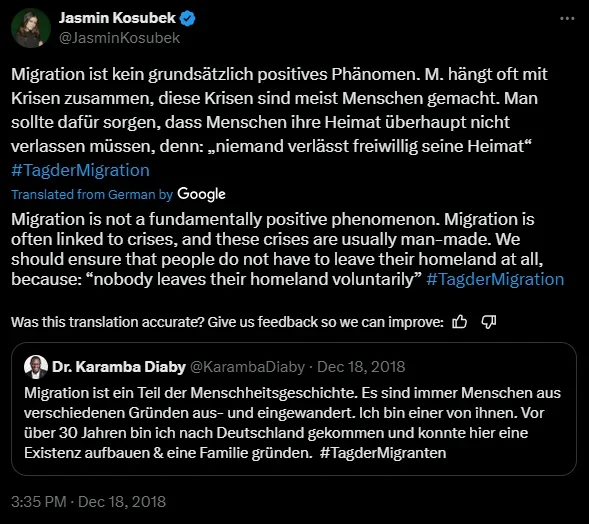
Image Description: A screenshot of a December 18, 2018, exchange on Twitter between German journalist Jasmin Kosubek and politician Dr. Karamba Diaby, discussing migration. Kosubek argues that migration is often driven by man-made crises and that people should not be forced to leave their homelands, while Diaby counters that migration is an enduring part of human history and can also create opportunities for building new lives and communities.
Credit: Jasmin Kosubek’s X profile (formerly Twitter), posted on December 18, 2018.
On International Migrants Day 2018, while she was still at RT, Kosubek replied to Karamba Diaby on Twitter (now called X). Diaby is an SPD member of the Bundestag who came to Germany from Senegal more than thirty years earlier and had written that migration is part of human history: ‘I am one of them.’ She answered: ‘Migration is not a fundamentally positive phenomenon.’ It is ‘often linked to crises’, those crises are ‘mostly man-made’, and one should ensure people never have to leave home at all, ‘because: “nobody leaves their homeland voluntarily”’.
The last line is a refugee-solidarity slogan, the sentence activists use to say that people who flee deserve protection. In her tweet it argues the opposite: migration is a symptom to be prevented, not a life to be lived. A Black man had written that he made a life in Germany. A white presenter at a Russian state channel told him, in effect, that his presence is evidence of a crisis. This is the same move I have traced through the podcast. A wound is acknowledged, here “nobody leaves voluntarily”, and then used to manage the wounded.
On one point I agree with Kosubek. Nobody leaves voluntarily, and I didn’t. I left Brazil because I was watching the movement that is now rising in Germany rise there first, under Bolsonaro, and because my artistic work brought me death threats from his supporters. The crisis that drove me out was, in her own words, man-made, and it was made by exactly the kind of politics Ganz ehrlich invites to sit at the table and explain itself. That is where my agreement ends. A diagnosis is useful only if it leads somewhere. Kosubek and Zeitner diagnose Germany at length, as traumatized, polarized and nervous, and they offer no alternative except more of the same diagnosis: another episode, another retreat, another sponsor’s course. I don’t see a platform for change in that. I see merchandising. They sell a feeling of understanding the crisis, while the people who produce it are welcomed with “space”.
IX. What the ancestors are for
I’ll end this essay where Zeitner’s ancestry search began, because he also told his viewers the most important sentence of the whole series. It was not his own. At an earlier summer retreat, he recalled, a woman from Namibia, a political figure, possibly a presidential candidate, looked at the room and asked, in his paraphrase: 'why do they need a retreat here to live with their ancestors?' He notes this is self-evident ‘in African cultures’ and in ‘indigenous’ contexts, where the ancestors are ‘a resource’.
He is right, and it matters more than he seems to realize. I wrote my master’s thesis on Pombagira and the Afro-Brazilian traditions in which the dead are present, demanding and political. In those traditions, Lélia Gonzalez’s Amefricanidade and Luiz Rufino’s pedagogy of the encruzilhada, the crossroads, ancestry is not a feeling to consult with a chatbot after a retreat. It is a set of obligations, and above all it is a memory of who was enslaved, who was expelled and who did the expelling. Audre Lorde knew that you can’t heal a wound by making it universal. Gloria Anzaldúa wrote from the border, not from a guest list. Their knowledge starts from injury and becomes solidarity. Ganz ehrlich starts from injury and becomes a pardon.
In the same episode in which a German healer felt the grief of ancestors expelled in 1918, his co-host defended the AfD against the charge of antisemitism and spoke of returning to Martin Sellner, the theorist of a new expulsion. Neither of them seemed to notice. Both of them called it honesty.
Honesty is a virtue between friends. In public, it is not the same thing as truth, and it never has been. For eleven years Jasmin Kosubek and Benedikt Zeitner have been telling each other everything. It’s time someone told them the rest.
Sources and further reading
Ganz ehrlich, episode 10 ('Ahnenheilung, kollektives Trauma, Flucht und Vertreibung, Antisemitismus in der AfD'), YouTube: https://www.youtube.com/watch?v=jEbP0nOEGc0
Ganz ehrlich, episodes 1–10, YouTube, @ganzehrlichpodcast:
Episode 1: https://www.youtube.com/watch?v=fZYePAz4wxU ·
Episode 2: https://www.youtube.com/watch?v=Q-C7Gxs3KQs
Episode 3: https://www.youtube.com/watch?v=uJyq4gFuwx0
Episode 4: https://www.youtube.com/watch?v=YKA-7LWwP6Q
Episode 5: https://www.youtube.com/watch?v=4WgLXz-SPzY
Episode 6: https://www.youtube.com/watch?v=HKKDFuJYpfI
Episode 7: https://www.youtube.com/watch?v=QxcO8HhNRAQ
Episode 8: https://www.youtube.com/watch?v=Wg0wAggu0g0
Episode 9: https://www.youtube.com/watch?v=V2rX-eY5J_Y
Episode 10: https://www.youtube.com/watch?v=jEbP0nOEGc0
Jasmin Kosubek with Benedikt Zeitner, ‘Scham und Schuld’ livestream, January 2026: https://www.youtube.com/watch?v=Yr2_hdcLnl4
Jasmin Kosubek with Benedikt Zeitner, ‘Trauma und Verschwörungstheorien’, 11 June 2022: https://youtu.be/WdXQaR65kic
Kira Ayyadi, ‘Jasmin Kosubek: Zwischen Döner-Witzen und Volksgemeinschaft’, Belltower.News, 22 June 2026: https://www.belltower.news/jasmin-kosubek-zwischen-doener-witzen-und-volksgemeinschaft-166133/
Correctiv, ‘Russische Propaganda für deutsche Zuschauer’, 4 January 2017: https://correctiv.org/aktuelles/neue-rechte/2017/01/04/russische-propaganda-fuer-deutsche-zuschauer
Stuttgarter Zeitung, ‘Jasmin Kosubek war Moderatorin von RT DE’: https://www.stuttgarter-zeitung.de/lokales/stuttgart/jasmin-kosubek-war-moderatorin-von-rt-de-schwaebin-macht-propaganda-fuer-putin-78888605.html
Jasmin Kosubek, tweet replying to Karamba Diaby, 18 December 2018
ESN Party, ‘ESN Party Celebrates Its First Sovereign Nations Summit in Berlin’, 27 June 2026: https://esn-party.eu/esn-party-celebrates-its-first-sovereign-nations-summit-in-berlin/
Abby Martin’s on-air statement on Crimea, Breaking the Set, RT America, March 2014
Marcelo Kuna, ‘„Mach deine eigene Recherche”: Wie die Rechte die Lieblingsgeste der Kritik geklaut hat’, Philosophie Magazin, 27 October 2026: https://www.philomag.de/artikel/mach-deine-eigene-recherche-wie-die-rechte-die-lieblingsgeste-der-kritik-geklaut-hat
Jason Ānanda Josephson Storm, The Genealogy of Genealogy (University of Chicago Press, 2026)
Catherine Liu, Traumatized: The New Politics of Public Suffering (Verso, 2026)
Audre Lorde, Sister Outsider; Gloria Anzaldúa, Borderlands/La Frontera; Lélia Gonzalez, ‘A categoria político-cultural de amefricanidade’; Luiz Rufino, Pedagogia das encruzilhadas
Kuna, M. (2023), M.A. thesis, Humboldt-Universität zu Berlin, DOI: 10.18452/26245
Quoted passages in the original German
Wording from the auto-generated transcripts, checked against the videos. Grouped by section, in the order they appear.
Opening
E10, ~19:11: „Dann habe ich mit Chat GPT Ahnenforschung betrieben … Und auf einmal spuckte der einen den Namen aus von dem Oscar Zeitner …"
E10, ~23:27: „… dass das genau die Haltung von denen ist, die z.B. viel AfD wählen oder politisch recht sich verorten, die halt sagen, ja, die Geschichte muss man jetzt ruhen lassen …"
E10, ~32:16: „… also den Vorwurf finde ich kann man der AfD nicht machen. … Also diesen Antisemitismus oder antijüdischen Vorwurf."
I. The guest list at the Babylon
Livestream Jan 2026, ~01:00: „Benedikt Zeit[ner], der Therapeut, der dein Leben verändern kann. … Wir kennen uns seit 11 Jahren. Wir haben uns kennengelernt auf einer Veranstaltung von Dr. Daniele Ganser vor 11 Jahren in Berlin."
E1 (no timestamp): „Ich hatte ihn kennengelernt, indem ich ihm einfach eine Mail geschickt hatte … ich kannte viele Videos von ihm zum 11. September von YouTube … Haben Sie nicht Lust in die Show zu kommen? … dass er irgendwie einmal im Jahr, wenn er in Berlin ist, ähm sehen wir uns … der hatte ein Vortrag in Babylon … ich kannte dich halt vom sehen von RT Deutsch und hatte halt die standardmäßigen Vorurteile irgendwie, dass du eine Nichte von Putin bist"
E10, ~1:01:07–1:02:48: „Ich frage mich, was hindert dich da zu sagen, nee, ziemlich klar nicht …" / „… die haben einfach andere Werte … Und deswegen für deren Verhältnisse gibt es so etwas wie Pressefreiheit. … das würde ich heute so nicht mehr sagen, weil die viele Journalisten sind gegangen."
E1, ~29:57–30:24 (Kosubek, then Zeitner): „… ich habe sofort dann an Menschheitsfamilie von Daniele Ganser gedacht und dann ist natürlich die Frage, wer gehört denn zu wir? … Gehören auch die Straffälligen zu wir …" / „… Leute, die hier straffällig werden oder die wirklich gegen unsere Kultur kämpfen, die sind zwar das wir der Menschheitsfamilie, aber sie sind dann vielleicht nicht das wir Europas oder das wir Deutschlands"
E8, ~20:09–21:42: „… Ukraine, sprechen Sie doch am besten mit Daniele Gansa." / „Das sind friedfertige Menschen, die Frieden in die Welt tragen. … friedlich ist nicht das erste Wort, was mir dazu einfällt."
II. 2022: 'my secret agenda'
Interview 2022, ~00:30, ~07:51–08:17: „… du bist halt [Heilpraktiker] und traumatherapeut hauptsächlich gemäß dem [NARM-]modell" / „ich war ja bei dir eine handvoll male" / „ich habe zwar schon viele leute zu dir geschickt"
Interview 2022, ~05:07, ~41:36: „der begriff verschwörungstheorie ist ja schon so ein kampfbegriff" / „ich bin großer fan davon ich habe so die heimliche agenda diesen begriff zu normalisieren"
Interview 2022, ~42:03–42:28: „[Daniele Ganser] hat gezeigt dass eigentlich fast alle kriege auf lügen basieren" / „auch wenn man die offizielle theorie des elften september glaubt … das ist eine verschwörungstheorie"
Interview 2022, ~31:18: „… diesen daten die wir da sehen nicht wirklich vertrauen können … die werden unter den tisch gekehrt"
Interview 2022, ~52:21: „… es interessiert mich auch nicht so sehr weil vieles in meinem leben was wirklich mich verändert hat war nicht wissenschaftlich unterstützt"
III. 'Giving them space'
E6, ~42:16–42:41: „ich will kein Melanie Am[ann] Interview führen. … Aber Nazis, also ich will nicht da rein verfallen, sondern wirklich ihnen das den Raum geben es auch erklären zu lassen."
Livestream Jan 2026, ~1:28:33: „… nächste Woche Donnerstag sitzt Götz Ku[bitschek] mir gegenüber …" / „Das ist einer der Momente, wo ich nicht mit Jasmin überein[stimme]"
Livestream Jan 2026, ~39:58–40:12: „ich werde ja linksliberal gelesen … dass ich so Bücher wie von Martin Se[llner] Remigration lese und dass ich den auf meinem Kanal habe … oder dass ich auch tendenziell vielleicht eher rechte Auswüchse habe be[im] Thema Migration"
E10, ~42:06–44:06: „ich halte dieses Buch Remigration von Martin Se[llner] für eine Anleitung zum Faschismus" / „… der brasilianische Schuhasku [Churrasco] wird schon nicht verboten werden, ne? Und ähm und und vielleicht stimmt es auch. Vielleicht meint er das so, weiß nicht, ob es das besser macht."
E10, ~44:32–44:58: „… ob ich noch mal ein Interview mache … aber die meisten Leute wollen halt nicht mit Martin Se[llner] sprechen … was schade ist"
E10, ~41:14: „Jetzt hat ja dort in Magdeburg auch das Institut für Remigration aufgemacht. Ich bin offensichtlich auf deren [News]letter"
E1, ~23:27–24:18 (Kosubek): „Ich war ja am Freitagabend war ich auf so einer Gala und dem European Sovereign Nation Summit im Klartext europäische Nationalisten. Ich habe damit kein Problem. … Schöne Gala, toll, tolle Veranstaltung im Westhafen … Waren auch ganz nette Leute da auch von der Jungen Freiheit … ich habe auch mit Anteilen von Remigration kein Problem."
IV. A therapeutic acquittal
E10, ~32:16–33:52: „… die haben sogar schon mal jemanden ausgeschlossen … Wolfgang Gedeon … auch Björn Höcke hat ja schon wiederholt gesagt, wie sehr er sich freut, wenn er von jüdischen Communities Zuspruch bekommt … das sagst du ja nicht, wenn du Antisemit bist … aber ich bin da eher bei dir"
E10, ~38:22: „… eigentlich muss sie natürlich ganz aus meiner Sicht ganz klar in Regierungsverantwortung kommen, weil sonst wird der Wählerwille nicht durchgesetzt."
E8, ~56:59: „… ich kann diese Reaktion durchaus nachvollziehen … damit will ich explizit nicht sagen, dass es nicht Kritikpunkte gäbe, vor allem bei Björn Höcke."
E9, ~59:47: „Und ich finde, dass diese Trauer total legitim ist … ich habe da ehrlich gesagt richtig Verständnis dafür"
E5, ~23:17–23:43: „… was ist uns angetan worden auf den Reinwiesen … dass einfach jede Perspektive da Raum bekommt … auch anzuerkennen, dass wir da auch Opfer waren … kollektives Trauma im im System"
E4, ~37:21: „… Alexander Gauland … Vogelschiss in mehr als 1000 Jahren deutscher Geschichte … der offenbart meiner Meinung nach eine Identifikation"
V. The left on the couch
Livestream Jan 2026, ~37:13–39:34: „… wenn sich jetzt einer, der eher rechtskonservativ ist, an einer grünen linken Feministin im Netz abreagiert …" / „… die Nazipsychose …" / „… dass ich da Ausgrenzungserfahrung gemacht habe oder auch Rassismuserfahrungen gemacht habe … Rechts, Nazi und so weiter auf einmal sehr bedrohlich wird"
E4, ~29:09, ~41:27–42:14: „gibt es Rassismus gegen Weiße?" / „… es ist eigentlich kein Rassismus gegen äh Weiße geben würde. Und dann der andere Punkt … dass immer der von Rassismus Betroffene der ist, der sagen darf, ob etwas rassistisch war. Und das finde ich also ganz problematisch"
Livestream Jan 2026, ~41:00: „… ich stell mir so billig die Opferpyramide vor und ganz oben ist natürlich irgendwie eine schwarze Translesbe oder sowas. Okay, es ist es ist absolut beschämend, dass ich hier äh so darüber spreche"
Livestream Jan 2026, ~59:32: „… diese Anspruchshaltung … bei Woken … Ja, fast schon mit Pronomen, ist ein optimales Beispiel dafür. … du kannst deine Umwelt nicht kontrollieren."
Livestream Jan 2026, ~1:19:50: „… so wie ich das auch der LGBTQ Bewegung vorwerfe … jetzt mittlerweile gibt's aber Forderung, wo ich sage, hör mal, das ist irgendwie ein bisschen zu viel"
E8, ~26:32: „… bei der AfD hat man ja so ein bisschen die Neonazis im Schlepptau und bei den Linken haben wir jetzt auf einmal die Clans im Schlepptau"
VI. 'We can discuss whether that's right'
Livestream Jan 2026, ~20:51–21:51: „Nennt sich im Volksmund StGB." / „Weil ich kann ja wirklich alles in Deutschland sagen, ohne dass ich mich strafbar mache … f[ü]hle ich abgrundtiefen Hass … habe ich destruktive Ideen, habe ich Ideen, ich möchte sie stoppen"
Livestream Jan 2026, ~23:57: „… also Holocaustleugnung ist jetzt ein spezielles Thema, das stimmt, ne? Da haben wir in Deutschland auch eine spezielle Geschichte. Gibt's auch Gründe, warum dieser Paragraph da ist und da kann man drüber diskutieren, ob das richtig ist, ne?"
Livestream Jan 2026, ~23:10, ~34:36: „… dass wir da diesen 188er Extra Paragraphen haben" / „Also ich bin auch der Meinung, dass wir ein Meinungskorridor haben"
Livestream Jan 2026, ~36:28: „… habe ich auch noch keine Hausdurchsuchung erlebt. … da habe ich wirklich Mitgefühl"
VII. The business of feeling safe
Livestream Jan 2026, ~1:27:35–1:28:10: „bitte folg Benedikt, sein Kanal" / „Ich habe genug Leute schon zu dir geschickt." / „dieser Therapeut kann Leben verändern. Es ist ein bisschen übertrieben … aber es stimmt auch."
E10, ~50:04: „… auf die Politik … geht's hier im Kern um eine Sache, um Trauma, was sich wieder und wieder inszeniert."
E1: „ich soll jetzt keine Verkaufsveranstaltung für deine Retreat sein"
Livestream Jan 2026, ~1:01:43–1:02:10: „… wir wollen beide irgendwie Klicks oder was auch immer."
Livestream Jan 2026, ~1:12:38: „Und deswegen habe ich auch überlegt, ob ich mal so ein Pöbelformat entwickel"
E5, ~11:00: „… wo ich richtig beleidigt wurde auch und ähm das ist ja immer ein Anzeichen, dass wir da irgendwie einen runden Punkt getroffen haben."
E8, ~01:12: „er war vernichtend für mich" / E9, ~18:39: „die Gewinnerin der Herzen" / E10, ~59:46: „das war wirklich wie so ein therapeutisches Outlet"
IX. What the ancestors are for
E10, ~25:35–26:10: „… diese Frau aus Namibia … wieso brauchen die hier ein Retreat, um mit ihren Ahnen zu leben? … in afrikanischen Kulturen … die sind eine Ressource"
Photo credit: © Marcelo Kuna