
Brasil! Mostra Tua Cara
On Sunday, October 4, 2026, Brazil’s over 158 million eligible voters will cast their ballots for both the federal and state levels — including for president. The shadow of US interference, however, looms and echoes a Latin American past difficult to be forgotten.
Show Your Face, Brazil!
On Sunday, close to a hundred and sixty million Brazilians will do something that sounds almost quaint from outside the country: they will be legally required to vote, all at once, for a president, two-thirds of the Senate, every seat in the lower house, and every state governor. I have lived outside Brazil for most of the last decade, long enough that explaining the mechanics of this to the people around me in Berlin has become its own small, recurring task — the compulsory ballot, the stack of votes eleven deep, the run-off that almost always follows a first round nobody wins outright. This essay is that explanation, written out properly for once, because the version of Brazil being discussed abroad this week — a culture-war curiosity, a proxy fight the United States has picked with a country it would prefer did not exist as an independent actor — is thinner than the country I am actually watching.
Three years after Brazil’s twenty-one-year civil-military dictatorship ended (April 1, 1964–March 15, 1985), and the same year its post-dictatorship Constitution was signed (October 5, 1988), the songwriter Cazuza released a track called simply ‘Brasil,’ written with Nilo Romero and George Israel for his album Ideologia. It became, almost by accident, one of the defining protest songs of Brazil's return to democracy: Gal Costa recorded her own version that same year for the opening titles of the telenovela Vale Tudo, and it is in her voice, more than Cazuza’s own, that most Brazilians of a certain generation first learned the refrain this essay borrows for its title. I will not reproduce the lyrics here — they belong to Cazuza’s estate, not to me, and he has been dead since 1990, of complications from AIDS, at thirty-two — but the demand inside that refrain is, I think, the only honest way to begin a text about what is happening in Brazil this week. Stripped to its sense rather than its words, the song asks the country to stop hiding behind its own spectacle and name, plainly, who profits from keeping things exactly as broken as they are. Sunday's election is, underneath everything else on the ballot, the same question asked again.
I should say plainly, before going further, what this essay is not. It is not an argument for Luiz Inácio Lula da Silva, from the Workers’ Party (PT) who is seeking an improbable fourth term, and it is not a brief against Flávio Bolsonaro, from the Liberal Party (PL), the senator now carrying his father’s movement into the race. Brazilians I respect are voting for both men, and more who are voting for neither, out of convictions I do not think a foreign reader needs me to adjudicate. What I want to do instead is slower, and I hope more useful: lay out, for people who do not spend their mornings reading Folha, O Globo or The Intercept Brasil, what has actually happened over the last four years, and why so much of it rhymes — uncomfortably, specifically, and not by accident — with a period of Brazilian history that the foreign press has mostly forgotten, and that the United States has not.
A Fractured Choice
Sunday is only the first round. If the pattern of the last several cycles holds — and polling two days out suggests it will — neither candidate clears fifty per cent of the valid vote, and the country returns to the polls on 25 October for a run-off. The headline contest is a rematch of blood rather than of men: Lula, seeking a fourth term after two decades in and out of the presidency, against Flávio Bolsonaro, the Rio de Janeiro senator whose own father cannot run again only because Brazil’s Supreme Court convicted him, in 2025, of plotting to stay in power by force.
But the first-round ballot is longer and stranger than that headline suggests, and the strangeness says something true about where Brazilian politics actually sits right now. Down-ballot candidates in Brazil have a long tradition of running under eye-catching nicknames rather than their given names — this cycle offers a Mick Jagger, a Shrek, a Frodo, each resembling their namesake closely enough to make the joke work — and the tradition extends, this year, all the way up to the presidential ballot, where a veterinarian is running on a platform built largely around free cosmetic Botox for low-income women, a pitch he has delivered through AI-generated videos strange enough that they became their own minor genre of viral clip, as the British comedian John Oliver documented, at some length, on a recent Last Week Tonight. It would be easy, watching from outside, to read this as comic relief from the main event. I think it is better read as a symptom. Brazilian vox pops collected ahead of the vote show a public far more fluent in disgust than in enthusiasm for either frontrunner — ‘neither,’ ‘nothing changes, only the flies change,’ one respondent telling an interviewer, asked to choose between Lula and Flávio, that he would rather take a bullet to the head. Roughly half of Brazilians tell pollsters they would never vote for Lula under any circumstance, and a very similar share say the same of Flávio. That is not the profile of a country settling a disagreement between two popular visions of itself. It is the profile of a country being asked, again, to choose the lesser of two exhaustions.
What has shifted, in the weeks before the vote, is the direction of that exhaustion's drift. Unemployment is at its lowest level since 2012, and Lula has leaned hard into a conflict with Washington that plays well domestically, turning Trump's tariffs into one of his most reliable applause lines on the stump. Flávio, half his father's age and considerably more careful with his public language, has been closing the gap anyway, running as what he calls a ‘vaccinated Bolsonaro’ — his father's politics without, he insists, his father's temperament. Whether that distinction survives contact with his actual record, and with the money now being traced through his campaign, is the subject of the next two sections.
Blood and Inheritance
Flávio Bolsonaro’s campaign rests on a contradiction he has chosen to make explicit rather than hide. In one widely circulated spot he looks into the camera and more or less says the quiet part aloud: that he may come across as calmer and more moderate than his father, but that the same blood runs in him regardless — an odd thing to offer as reassurance, and John Oliver was not wrong to call it that on Last Week Tonight. In another, he leans on his wife and mother to soften the inheritance, crediting the women in his life for whatever decency he can claim. The two ads do not quite agree with each other, which is, in its way, the whole campaign in miniature: Flávio wants to be read as the Bolsonaro without the baggage, while never once disclaiming the baggage itself.
It is worth being specific about what ‘the same blood’ is actually asking a listener to forgive, because the warning only lands if the history behind it is visible. In December 2014, after the federal deputy and former human-rights minister Maria do Rosário accused Jair Bolsonaro on the floor of the Chamber of being an apologist for the dictatorship's torturers, he told her, more than once, that he would not rape her, because she did not deserve it. The remark earned him a civil conviction for damages and, separately, criminal proceedings before the Supreme Court. That is the specific inheritance Flávio is asking a foreign audience, implicitly, to read as softened rather than renounced.
There is also a literal reading of ‘vaccinated’ sitting underneath the political one, and it does Flávio no favors either. His father spent the opening year of the pandemic calling COVID-19 a ‘little flu,’ telling a reporter who asked for the death toll that he was ‘not a gravedigger,’ undermining state lockdowns, and pushing an unproven malaria drug ahead of the vaccines his government spent months refusing to procure. When Jair caught the virus himself in 2020, he marked the occasion by holding a box of that same drug up to the cameras rather than reconsidering it. Brazil finished his term with close to seven hundred thousand recorded COVID deaths and one of the worst death rates per capita of any country its size; a Senate inquiry concluded that several hundred thousand of those deaths need not have happened, and recommended criminal charges against seventy-eight people over the handling of the pandemic. Flávio Bolsonaro’s name was already on that list, years before he started branding himself the vaccinated one. Prosecutors shelved the case. Brazilian voters, largely, have not.
The record makes the strategy difficult to sustain. Flávio Bolsonaro has called homosexuality abnormal and said, in terms he has not walked back, that he finds the sight of two men kissing distasteful. He has defended Brazil’s twenty-one-year military dictatorship as a period of order, healthcare and respect, a description that asks a listener to forget the thousands who were tortured, killed or disappeared for opposing it. On crime, his platform calls for a markedly more punitive approach, including five new prisons built on the model El Salvador has used to house tens of thousands of people with minimal due process. And on foreign alignment, he has drawn close to Israel’s Benjamin Netanyahu and Argentina’s Javier Milei, part of a broader turn toward the international hard right that reached its most startling expression this March, when Flávio addressed the Conservative Political Action Conference in Texas and asked the United States, in front of one of the American right’s largest annual gatherings, to apply pressure on Brazil’s own institutions ahead of the vote — a request from a man hoping to lead one of the world’s largest democracies that The Brazilian Report did not exaggerate in calling unthinkable, coming from anyone seriously trying to govern the country he was asking Washington to lean on.
That request did not stay rhetorical. What Flávio asked for in Texas, the United States government has spent the months since supplying, in forms a great deal more concrete than a standing ovation — which is the subject of a later section of this essay. First, though, there is a nearer, stranger story to tell, because the same senator asking a foreign government to intervene in his country’s institutions has also spent this year explaining, with diminishing success, where the money for his father's biopic came from.
The Palace That Could Not Be Repaired, and Was
For readers outside Brazil, the clearest entry point into why any of this matters is a date from early in Lula’s current term: 8 January 2023. A week after Lula’s inauguration for his third term, thousands of Jair Bolsonaro's supporters, who had spent the two months since his election loss camped outside military barracks demanding the armed forces overturn the result, marched on the Praça dos Três Poderes in Brasília and stormed all three of its buildings at once — the National Congress, the Planalto presidential palace, and the Supreme Federal Court. The US-American reader will recognise the shape of the day immediately, because it is the shape of 6 January 2021 in Washington, down to the conviction, shared by both crowds, that an election they had lost had in fact been stolen from them. Brazil's version lasted longer, by some measures did more structural damage, and ended, eventually, in prison sentences that the 6 January rioters’ US-American counterparts have, for the most part, not faced.
What the invaders destroyed inside those buildings is worth dwelling on precisely, because it is the detail a foreign reader is least likely to have encountered. The rioters who broke into the Planalto did not only smash windows and flood the floors with fire hoses; they went after the presidency’s own art collection, item by item. Among the roughly twenty works damaged or destroyed that afternoon were Di Cavalcanti’s painting As Mulatas, a seventeenth-century table clock attributed to Balthazar Martinot and André-Charles Boulle, Bruno Giorgi’s sculpture O Flautista, Marta Minujín’s sculpture Vênus Apocalíptica Fragmentando-se, a portrait of the nineteenth-century general Duque de Caxias by Oswaldo Teixeira, and canvases by Clóvis Graciano, Glênio Bianchetti and the British painter John Piper — pieces that had nothing to do with any living politician and everything to do with the idea that the republic has a memory worth keeping intact. More than two thousand people were arrested in the weeks that followed.
Here the story takes a turn a simple tale of irretrievable loss would miss. Brazil's national historical and artistic heritage institute spent the following year and a half, in partnership with a federal university’s conservation laboratory, painstakingly restoring what had been broken rather than writing it off, and on the second anniversary of the attack, 8 January 2025, Lula and First Lady Janja presided over a ceremony returning the restored works to the Planalto’s walls, with Janja telling the room that putting the art back on this particular date was itself a statement about the alliance between culture and democracy. I find that detail more affecting than a story of permanent loss would have been, not less: it is one more way of answering the question the title of this essay is borrowed from. Somebody had to pay, in restorers’ hours and public money, for the country to be made whole again after a mob tried to prove it could not be.
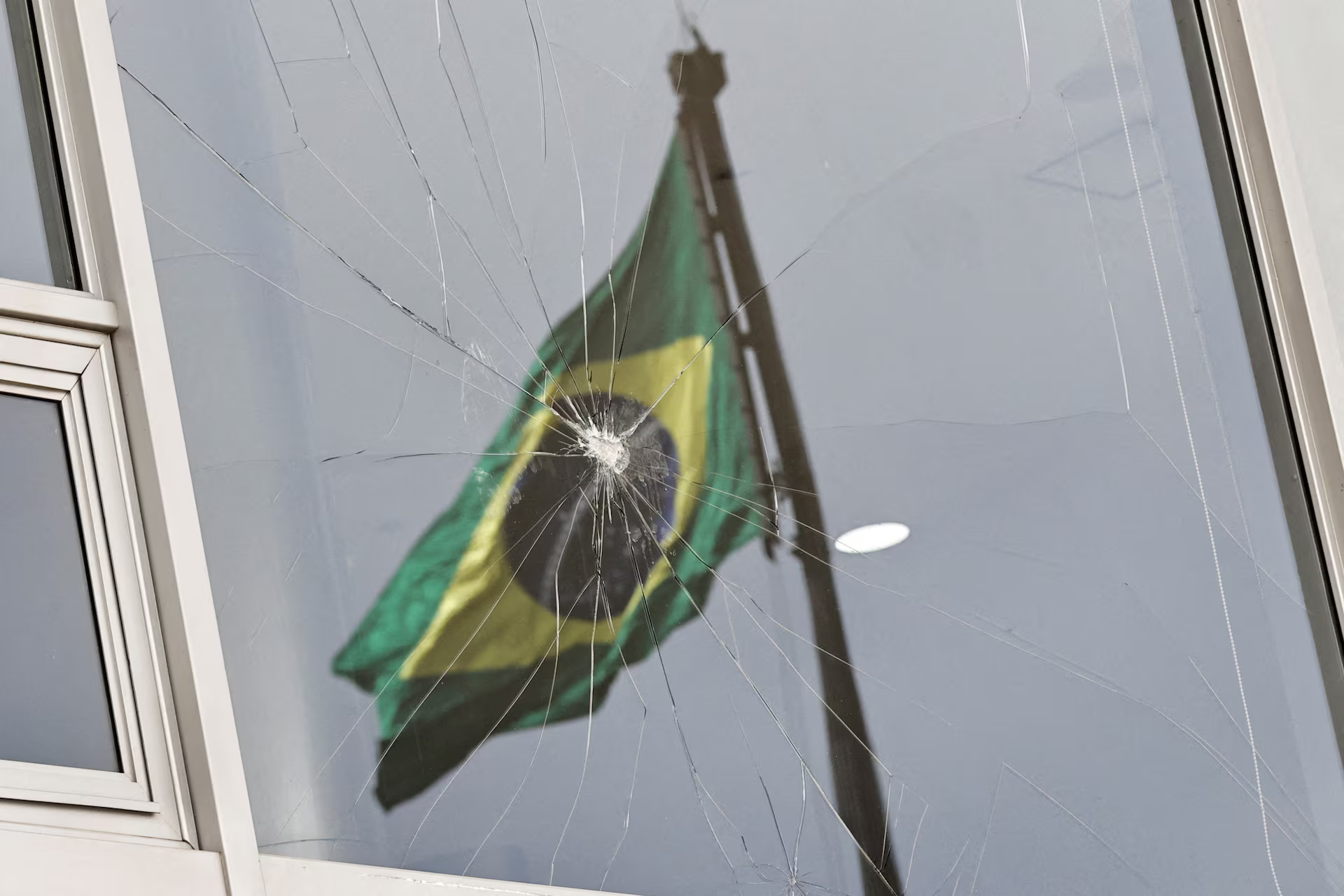
Image Description: An empty concert stage illuminated in cool blue light and enveloped in thick, swirling theatrical smoke. Several microphone stands, keyboards, electronic equipment, and drums are arranged across the stage, with cables running along the floor and two water bottles near the front. No performers are present, giving the scene an atmospheric sense of anticipation—as though the stage is waiting for the performance to begin.
Credit: © Reuters
Dark Horse
Somewhere in pre-production on a feature-length biopic of Jair Bolsonaro, titled Dark Horse and starring the US-American actor Jim Caviezel, someone had to pay for it, and in May this year The Intercept Brasil reported, with messages and audio to back it up, exactly who that was. According to the outlet’s reporting, Flávio Bolsonaro personally negotiated roughly 134 million reais (something over twenty million US dollars) from the banker Daniel Vorcaro to bankroll his father’s story; Vorcaro, in turn, was the owner of Banco Master, a mid-sized lender that had grown its balance sheet nearly twenty-five-fold in five years and that Brazil’s Central Bank ordered liquidated in November 2025 amid a fraud investigation now running into the billions of reais. Flávio initially denied any connection between the film and Vorcaro. Once The Intercept’s documents made the denial untenable, he confirmed he had asked for the money but insisted he had received nothing improper in return. His brother Eduardo, a federal deputy and, per a November 2023 contract the outlet later obtained, one of the film’s formally listed executive producers alongside the actor-turned-congressman Mário Frias, had made a nearly identical denial days earlier, and it did not survive the documents either; messages showed Eduardo issuing instructions on how the money should be routed to the production’s expenses in the United States. In July, Supreme Court Justice André Mendonça authorized a federal police inquiry into the roughly sixty-one million reais that appear to have actually changed hands.
There is something almost absurdist in the margins of the story, which is worth a sentence precisely because the absurdism does not cancel out the seriousness. John Oliver’s programme, working from the same reporting, noted that the wig rented for Caviezel’s performance alone cost the production the equivalent of two thousand dollars, and the leaked early draft of the screenplay reads, by every account including Oliver’s, like state propaganda that forgot to disguise itself as drama: it recasts a stabbing that every investigation concluded was the act of a single disturbed individual as a conspiracy authored by the courts, the press and an invented left. The film’s own distributor has since postponed its release until after Sunday’s vote, which means Flávio will get none of the hoped-for boost from it at the polls, and will go on answering, for the length of a federal investigation, for where twenty-odd million dollars of a now-collapsed bank's money actually went.
It is tempting to read Dark Horse as a story about vanity, a son trying to buy his father a kinder legacy on film. I think that reading undersells it. A sitting senator who has asked a foreign government, from a stage in Texas, to lean on his own country’s institutions was simultaneously running an opaque, now-investigated financing operation through a bank that collapsed under suspicion of fraud, to fund a work of cinema designed to rehabilitate the image of a convicted coup plotter three days before that plotter’s son stood for president in his place. None of this requires speculation about intent. It requires only arithmetic, and the arithmetic is the point.
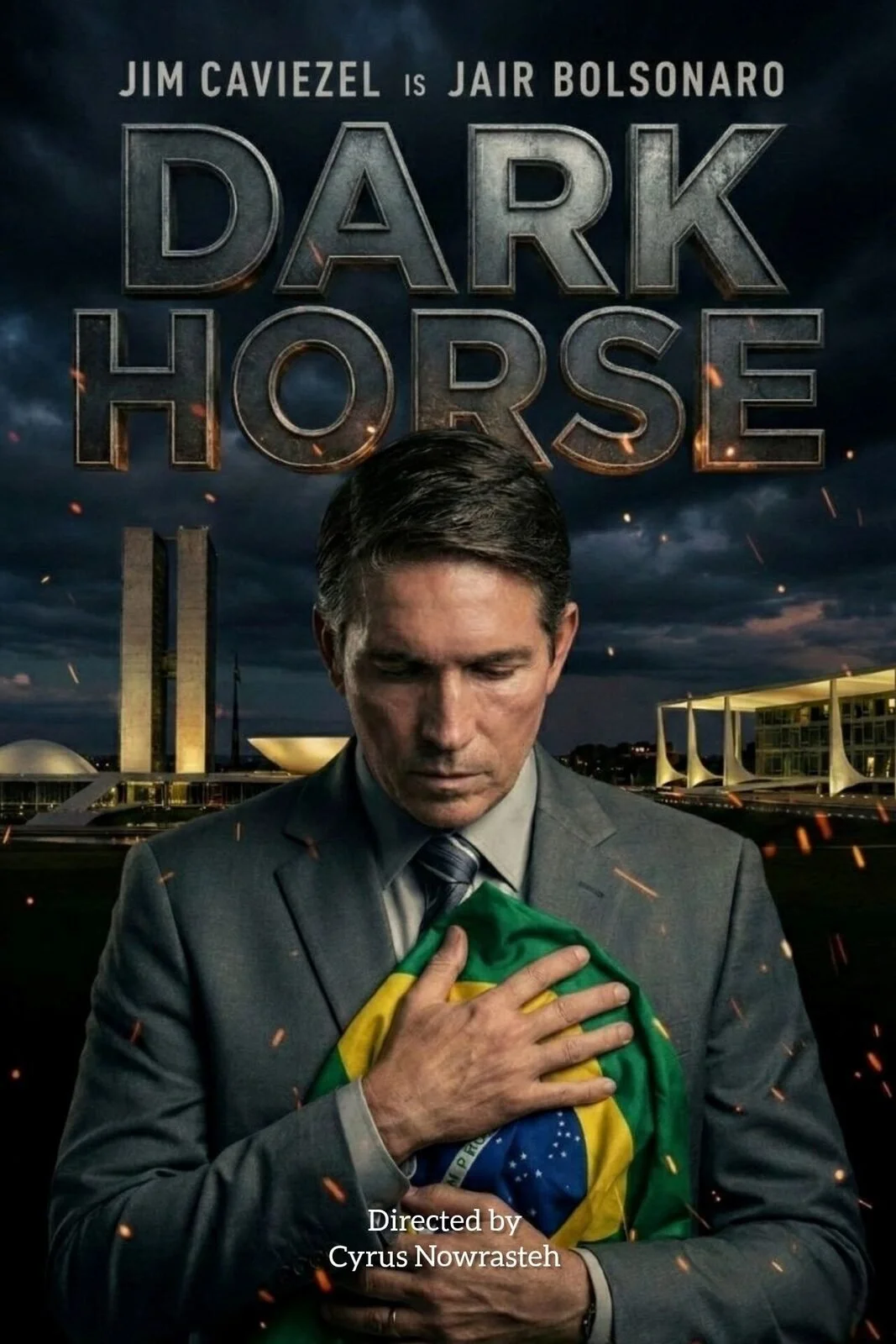
Image Description: A promotional poster for Dark Horse, a biographical drama about Jair Bolsonaro directed by Cyrus Nowrasteh. The poster features actor Jim Caviezel portraying Bolsonaro, standing in front of Brazil’s National Congress in Brasília while holding a Brazilian flag against a dark, stormy sky. Large metallic lettering reads “DARK HORSE,” with the tagline “JIM CAVIEZEL IS JAIR BOLSONARO” above it and “Directed by Cyrus Nowrasteh” below. The film focuses on Bolsonaro’s political rise during the 2018 presidential campaign.
Credit: © DarkHorseMovie
Washington’s Long Shadow
Here is the contrast worth sitting with, because it is the cleanest measure of how much has changed in four years. In 2022, the United States recognized Lula’s election win within half an hour of Brazil’s electoral court announcing it — a speed that analysts in Brasília still credit with helping cool a military establishment some feared might entertain Jair Bolsonaro’s refusal to concede. The government making that call was Joe Biden’s. The government in Washington today is Donald Trump’s, and on the question of this Sunday’s vote it has not been a neutral bystander for a single week of the campaign.
The pressure has come in layers. Trump has already used a fifty per cent tariff on Brazilian imports, announced last year, explicitly in defence of Jair Bolsonaro, calling the coup trial a ‘witch hunt’ that should end immediately; his administration has sanctioned Supreme Court Justice Alexandre de Moraes and other federal officials involved in prosecuting Bolsonaro’s allies, and in August it took the unprecedented step of revoking the visa of Brazil’s own ambassador in Washington, Maria Luiza Viotti, a move Washington framed as retaliation for delays in approving a new US-American ambassador but which Brazilian officials read as plain intimidation. In July, the US consulate in São Paulo held a closed-door meeting with a hand-picked group of Brazilian right-wing influencers to discuss, among other things, whether content-moderation rules could be said to be interfering with the election — an event several Brazilian outlets have since cited as exactly the kind of quieter, below-the-headlines involvement that Celso Amorim, Lula’s special advisor on international affairs, recently described to Congress, without much ambiguity, as happening ‘infiltradamente.’
Flávio has not merely tolerated this; he has solicited it. He visited Trump at the White House in May, less than two weeks after The Intercept’s first Dark Horse reporting broke, and came home with a public endorsement: Trump posted a photograph of the two of them from the Oval Office calling Flávio a sharp young man who loves his country very much. The Intercept Brasil has reported, separately, that US-American officials have been meeting Flávio directly at his Washington hotel, and that the US state apparatus has, in the outlet’s own phrase, been used to lift his candidacy in exchange for commitments that reportedly include greater access for the US to Brazil’s reserves of rare-earth minerals. A Brazilian businessman named Tales Gomes, tied to Flávio's circle and to the Rockbridge Network — a conservative donor network co-founded by Vice President JD Vance — has spoken openly, alongside the investor Chris Buskirk, of a ‘civilizational alliance’ between the two countries; Gomes confirms his Rockbridge ties but denies any formal campaign role or donation. Brazil’s intelligence agency has separately flagged a wave of posts, amplified from the United States, pointing to prediction markets like Polymarket as evidence Flávio is the stronger candidate — a claim actual polling does not support, which is rather the point of laundering it through a betting market instead.
Lula’s party (the Workers’ Party, PT) has asked both the Supreme Court and the electoral tribunal to investigate whether this adds up to foreign interference serious enough to disqualify Flávio’s candidacy outright, and whether US-American money reached the campaign through channels the Constitution prohibits. The administration itself has been carefully vaguer about its preferences than Trump or Flávio have, which has not stopped one Brazilian investigative outlet from naming the pattern in a verdict I have not been able to improve on: Agência Pública has concluded that Washington’s intervention this year is without precedent in Brazil's democratic history — except for the one time the United States helped install a dictatorship instead.
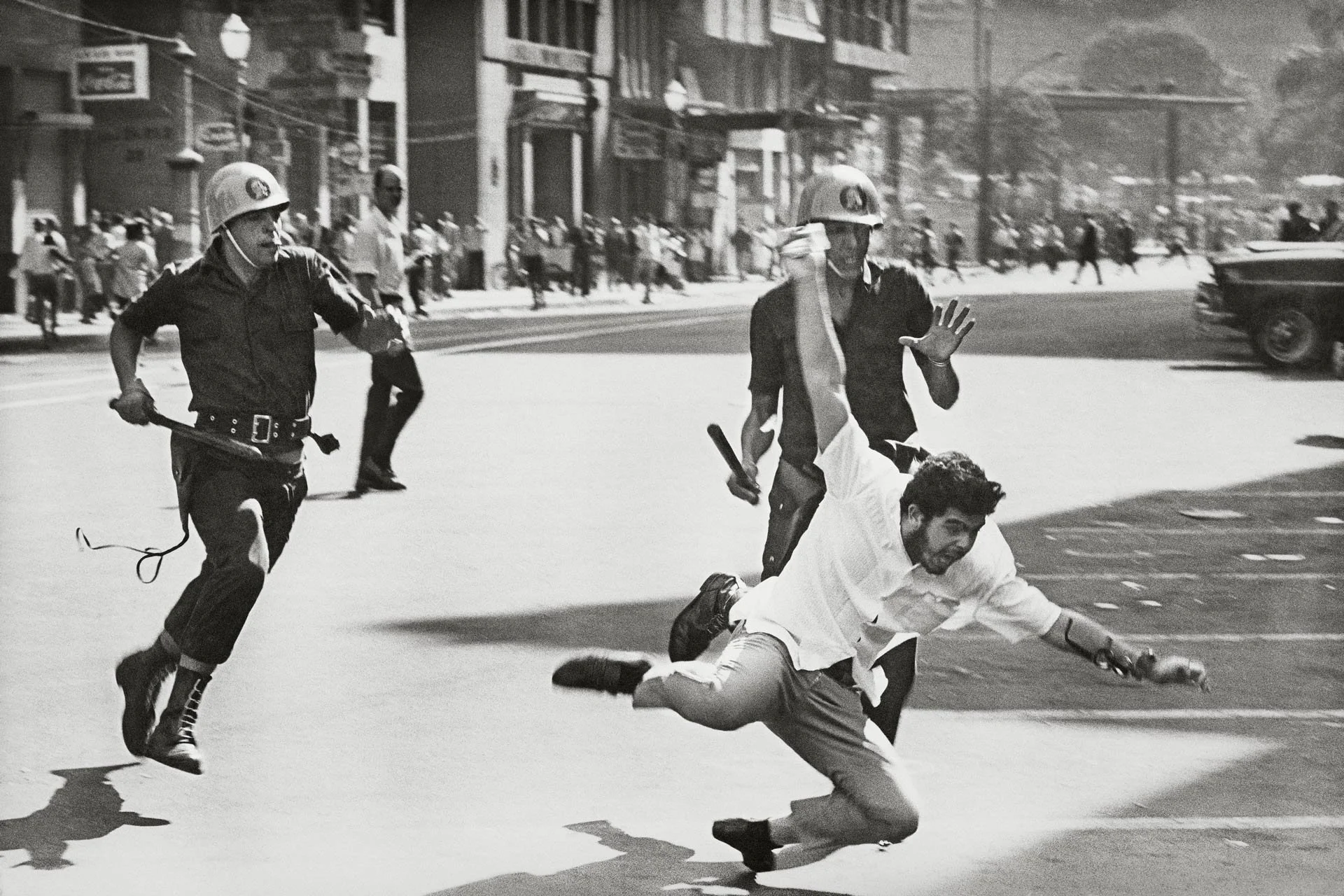
Image Description: This image depicts a Brazilian military-police crackdown on a civilian in the street, rendered in stark black and white. The central action is highly dynamic: a person in civilian clothing appears to be falling or being struck while two helmeted officers pursue them with batons. The composition emphasizes the asymmetry of the encounter—the civilian is exposed and off-balance in the foreground, while the uniformed officers advance from behind. The blurred crowd and architecture in the background give it the visual character of documentary/photojournalistic imagery associated with political repression during Brazil's military dictatorship (1964–1985).
Credit: © Evandro Teixeira, Acervo IMS/Coleção Evandro Teixeira
1964, Again
The one time in question is worth naming precisely, because US-American readers in particular are rarely taught it. On 31 March 1964, Brazil’s military moved against President João Goulart (1919–1976), popularly known as Jango, a democratically elected reformist the Brazilian establishment and the United States had both come to see as dangerously close to the Brazilian Communist Party. The Kennedy and then Johnson administrations had spent more than two years cultivating the officers who would eventually lead the coup, and when it came, Washington had a military operation standing by, code-named Brother Sam: a naval task force built around the aircraft carrier USS Forrestal, tankers loaded with fuel, and aircraft loaded with ammunition, ready to back the plotters if Goulart’s government put up a fight. He did not. The coup succeeded so quickly and so quietly that Brother Sam never had to cross into Brazilian waters, and Washington recognized the new military government within hours, relieved, in the words of the US ambassador at the time, Lincoln Gordon, to have averted what he feared might otherwise have made Brazil ‘the China of the 1960s.’ The dictatorship that followed lasted twenty-one years, tortured and killed an uncounted number of its own citizens, and is the same period Flávio Bolsonaro has praised on this year’s campaign trail for its order and its respect.
I am not reaching for a metaphor here; I am describing a continuity that Brazilian officials and journalists have themselves been naming all year, usually in more guarded language than I am using. The documents proving Washington’s hand in 1964 — Gordon's own cables among them — stayed classified for over a decade and were only confirmed, piece by piece, from the mid-1970s onward, long after the dictatorship they enabled had hardened into fact. The pattern they reveal is not unique to Brazil: across the 1960s, '70s and '80s, Washington extended comparable support, sometimes decisive and sometimes merely permissive, to military governments across Latin America that described themselves, as Brazil’s did, as holding the line against Communism. What is different about 2026 is not the goal — a hemisphere realigned toward Washington and away from its rivals, with the local right installed to guarantee it — but the method. Nobody needs to improvise an aircraft carrier off the coast this time. A tariff, a sanctions list, a revoked visa, a friendly meeting with the right influencers, a photograph in the Oval Office: the instruments are gentler, in the sense that none of them requires a uniform, and considerably cheaper to deny.
Those Who Left
I want to end closer to home, because the diaspora is where I actually stand to watch all of this, and because its vote tells its own small, specific story about what the Bolsonaro years cost. In the 2018 run-off, Brazilians voting abroad broke for Jair Bolsonaro by a landslide — seventy-one per cent. Four years and one pandemic, one insurrection and one coup trial later, that majority did not just soften; it reversed. Lula won 51.3 per cent of the valid vote among Brazilians abroad in 2022, carrying nearly every European city where Brazilians cast ballots, Athens the lone exception, and clearing seventy per cent of the vote outright in four of them: Paris, Dublin, Amsterdam, and Berlin, where the final tally ran to something close to six votes in seven for Lula. I was not yet watching Berlin’s Brazilian community as closely as I do now, but I believe that number without needing to have counted it myself, because it matches everything I have since come to recognize in the diaspora here: disproportionately queer, disproportionately in the arts, disproportionately people who left in part because of exactly the political current now trying to return home dressed in a more ‘vaccinated’ suit.
It is worth being precise about what that number does and does not mean, in the spirit of the complexity I promised at the start of this essay. A Brazilian who emigrates to Berlin or Paris is not a representative sample of Brazil; voting abroad selects, among other things, for people with the money and the paperwork to have left in the first place, and for the specific grievances that made leaving feel necessary. The diaspora’s near-unanimity for Lula is not proof that Brazil as a whole secretly agrees with it. It is proof of something narrower and, to me, more moving: that a great many of the people Brazil’s recent politics pushed out are still, from exile of a kind, trying to answer the question the country keeps asking itself. Show your face. We are watching from here too, and we have not looked away.
Show Your Face, Again
Whatever happens on Sunday, and whatever happens three weeks later if, as expected, a run-off decides it, Brazil has already shown a good part of its face over the last twenty months: a face that asked a foreign government to lean on its own courts, financed part of its own myth-making with a collapsed bank’s money, and discovered, again, that something close to half the electorate would rather not look closely at either candidate on offer. There is a second face in this story too, the one being assembled in slower work the extremists could not undo — restorers in Brasília fitting a seventeenth-century clock back together piece by piece, European governments reportedly coordinating in advance how they will respond if Washington refuses to recognise a result it dislikes, a diaspora voting, again, from kitchens in Berlin and Paris for a country some of its members have not lived in for a decade. None of that is proof of how Sunday will go. It is proof that the question Cazuza and Gal Costa put to the country in 1988 never actually closed; Brazil simply agreed, every few years, to answer it again.
I said at the start that I would not use this essay to tell a foreign reader whom to want to win. I am going to keep that promise all the way to the last sentence, because I think the more useful thing I can leave you with is not a verdict but a question properly understood — which is, after all, the only thing the song itself ever actually offered. Brazil is being asked, one more time, who is paying for it to stay this broken, and whether the people doing the asking still have the standing, after everything above, to be trusted with the answer. On Sunday, a hundred and sixty million people will start giving theirs. The rest of us, from Berlin, Paris, Amsterdam or Washington and wherever else is watching, do not get a vote. We only get to keep paying attention, which is its own kind of answer, if we actually do it.
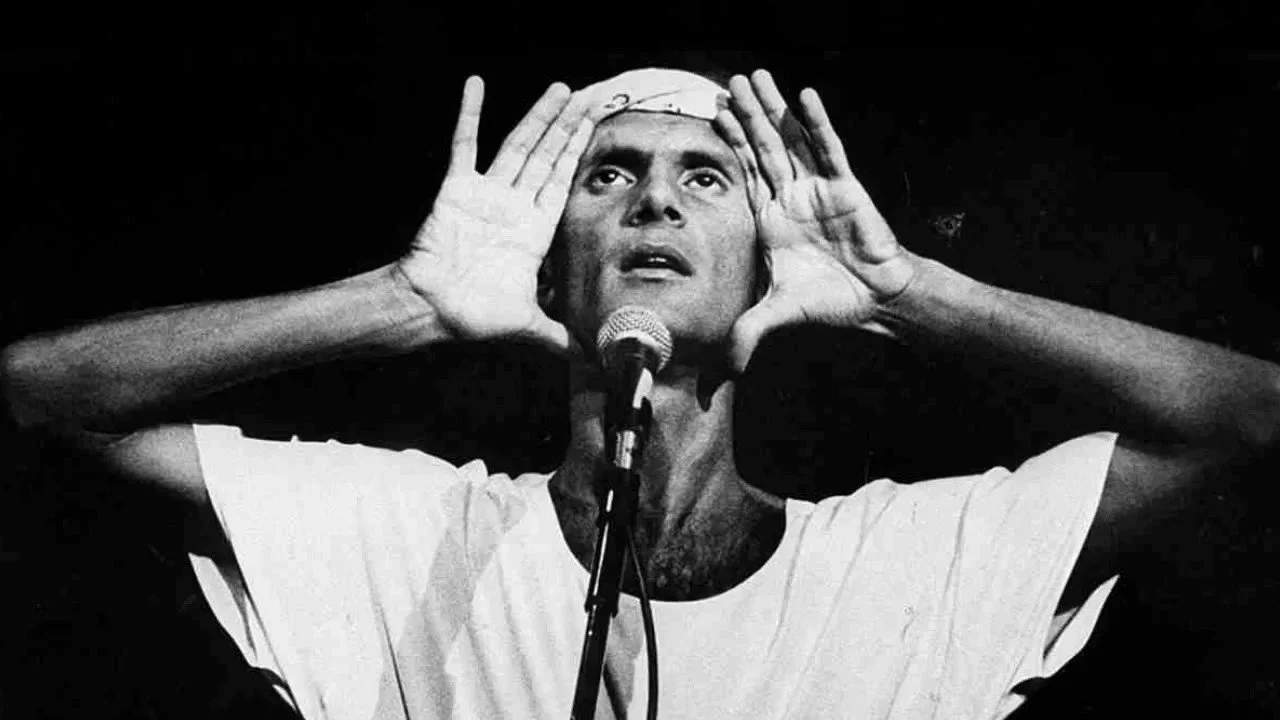
Image Description: A black-and-white photograph of Brazilian singer and songwriter Cazuza performing on stage. Standing behind a microphone, Cazuza raises both hands to either side of the face, framing the head in a striking theatrical gesture. The image captures the intensity and expressive physicality of a live performance. The photograph was taken during a concert at the Palace in São Paulo.
Credit: © Masao Goto Filho/Folhapress
Sources and further reading:
John Oliver, segment on Brazil's 2026 election, Last Week Tonight, HBO, September 2026: youtu.be/MIYCek92ICQ.
João Fellet, on US interference in Brazil's 2026 election, BBC News Brasil, September 2026: youtube.com/watch?v=8bYaiPD3G3k.
'Lula obteve 51,3% dos votos válidos dos brasileiros no exterior', Nexo Jornal, 5 November 2022: nexojornal.com.br.
'Lula mantém vantagem e vence no exterior', Poder360, November 2022: poder360.com.br.
Phyllis Parker, Brazil and the Quiet Intervention, 1964 (University of Texas Press); 'Operation Brother Sam' and '1964 Brazilian coup d'état', Wikipedia; Library of Congress Research Guides, 'The United States and Brazil's Military Coup (1964)': guides.loc.gov.
'Reintegração de obras de arte destruídas em 8 de janeiro', Congresso em Foco, 8 January 2025: congressoemfoco.com.br.
'Planalto começa a receber obras de arte restauradas após serem danificadas no 8/1', CNN Brasil: cnnbrasil.com.br.
‘EXCLUSIVO: Eduardo Bolsonaro tinha poder sobre dinheiro do "Dark Horse", revela contrato’, The Intercept Brasil, 15 May 2026: intercept.com.br.
'Produtora de "Dark Horse" esconde da Ancine quem mandava no dinheiro de Vorcaro', The Intercept Brasil, 4 September 2026: intercept.com.br.
'Eleições 2026: Grande imprensa ignora interferência dos EUA na democracia do Brasil', The Intercept Brasil, 29 August 2026: intercept.com.br.
'Os EUA já estão interferindo nas eleições brasileiras', Agência Pública, 26 August 2026: apublica.org.
Gustavo Ribeiro, 'Inviting foreign interference', The Brazilian Report, 30 March 2026: brazil.substack.com.
‘Brasil tenta se blindar de interferência dos EUA nas Eleições 2026, diz NYT’, Metropoles, October 2026, reporting on The New York Times: metropoles.com.
On Cazuza’s ‘Brasil’ (1988) and Gal Costa's recording for the opening of Vale Tudo: Enciclopédia Itaú Cultural and Cultura Genial: enciclopedia.itaucultural.org.br, culturagenial.com.
‘Flavio Bolsonaro enters Brazil's 2026 presidential race with father’s nod’, Al Jazeera, 6 December 2025: aljazeera.com.
Photo credit: © Folhapress