
Riesenbaby: failure to launch or societal collapse?
Have people become more coddled and extremely sensitive to criticism, or are we simply evolving to a society where disagreement is being disregarded in favour of egocentric echo chambers?

Image Description: A man with freshly shaven head is seen sucking on a large pink pacifier, and his eyes are wide open staring at the observer/photographer. He’s wearing a black T-shirt, and he has light stubble facial hair.
Out all of the social remarks about my personality, the recurring theme seems to be worded as in: “You are so intense!” or “You speak so loud!”. In a conformist culture such as the German, to hear these comments on a daily basis can become really exhausting.
But what has been getting my attention lately is how this sensitivity to my presence usually comes together with a specific type of faux-criticism: outrage disguised as friendly advice. It seems to me that no one is able to feel discomfort anymore, and any social friction is punished with reprimands that are meant to other one’s nonconformist attitude as a problem to be fixed.
Because of that, Ican’t shake the feeling that we are surrounded by “Riesenbabys”—the German expression for someone who behaves immaturely (sort of an equivalent to the English idiom “man-child”, but not gender specific).
And I don’t mean actual children, but adults. Fully grown, tax-paying, LinkedIn-using adults who somehow lost the ability to handle the mildest form of discomfort without spiraling into outrage, moral judgment, or emotional collapse.
And before you say it — yes, I know.
“We just care more now.”
“We’re more aware.”
“We’re kinder.”
Sure.
But are we also becoming… unbearable?
The Death of “Just Deal With It”
There used to be a basic life skill:
Someone says something you don’t like, so you just deal with it.
Not because it’s pleasant.
Not because it’s fair.
But because that’s what functioning adults do.
Now?
Someone says something slightly off, slightly clumsy, slightly not optimized for maximum emotional safety — and suddenly we’re in a full-blown ethical crisis.
A comment about someone’s appearance? Problematic.
A blunt piece of feedback? Toxic.
A joke that doesn’t land? Harmful.
Everything is escalated. Everything is felt. Everything is processed.
And almost nothing is just… ignored.
The Expanding Bubble Wrap
We’ve created a culture that increasingly wraps everything in bubble wrap.
Words need disclaimers
Opinions need softening
Conversations need moderation
And the list of things that might “hurt” someone keeps expanding.
To be fair, some of this is overdue. There’s no glory in being unnecessarily rude or dismissive.
But here’s the problem:
The line didn’t just move — it’s still moving.
What counted as normal ten years ago is now questionable.
What’s acceptable today might be offensive tomorrow.
At this rate, the only safe thing to say will be nothing at all.
Criticism = Violence (Apparently)
One of the strangest developments is how criticism has been reframed.
It’s no longer:
“I disagree with you.”
It’s:
“This is not okay.”
Or worse:
“This is harmful.”
That’s a massive shift.
Because if criticism becomes harm, then disagreement becomes aggression.
And once you’re in that frame, the logical next step isn’t discussion — it’s protection.
From ideas.
From opinions.
From each other.
The Comfort Addiction
Let’s be honest: comfort is addictive.
And we’ve gotten very, very good at maximizing it.
We curate our feeds so we don’t see opinions we dislike.
We surround ourselves with people who think similarly.
We avoid situations where we might feel awkward, challenged, or exposed.
Again — individually, totally understandable.
But collectively?
We’re training ourselves to expect a world that never pushes back.
And when reality inevitably does, the reaction isn’t:
“Okay, let me handle this.”
It’s:
“This shouldn’t be happening.”
A Fragile Kind of Strength
What makes this tricky is that it often comes disguised as strength.
Setting boundaries.
Calling things out.
Standing up for yourself.
All good things.
But there’s a thin line between having boundaries and having zero tolerance for discomfort.
Between self-respect and hypersensitivity.
Between emotional awareness and emotional overreaction.
And I’m not sure we’re great at telling the difference anymore.
Social Media Made It Worse (Obviously)
Of course, none of this exists in a vacuum.
Social media rewards the most intense reactions.
Outrage gets attention.
Victimhood gets validation.
Nuance gets ignored.
So what do people learn?
Be louder.
Be more offended.
Be more affected.
Because that’s what works.
Over time, that doesn’t just change behavior — it shapes identity.
So… Have we become Riesenbabys?
Yeah. A bit.
Not everyone. Not always. But enough that it’s noticeable.
And the danger isn’t that people are “too sensitive” — that’s too simplistic.
The danger is that we’re losing the ability to handle friction.
To hear something we don’t like without collapsing or escalating.
To separate intention from impact.
To accept that not everything needs to be corrected, challenged, or condemned.
Maybe the Problem Isn’t the World
Here’s the uncomfortable thought:
What if the world didn’t become harsher…
we just became less tolerant of it?
What if instead of making ourselves more robust, we tried to make everything else more gentle — and now we’re surprised it doesn’t work?
A Radical Idea
Maybe — and this is controversial these days —
we should bring back a slightly underrated skill:
Being okay with things that are not okay.
Not endorsing them.
Not celebrating them.
Just… enduring them.
Letting small things be small.
Letting awkward moments pass.
Letting imperfect people be imperfect.
Because if we can’t do that,
we don’t just end up with a kinder world.
We end up with a more fragile one.
Full of Riesenbabys.
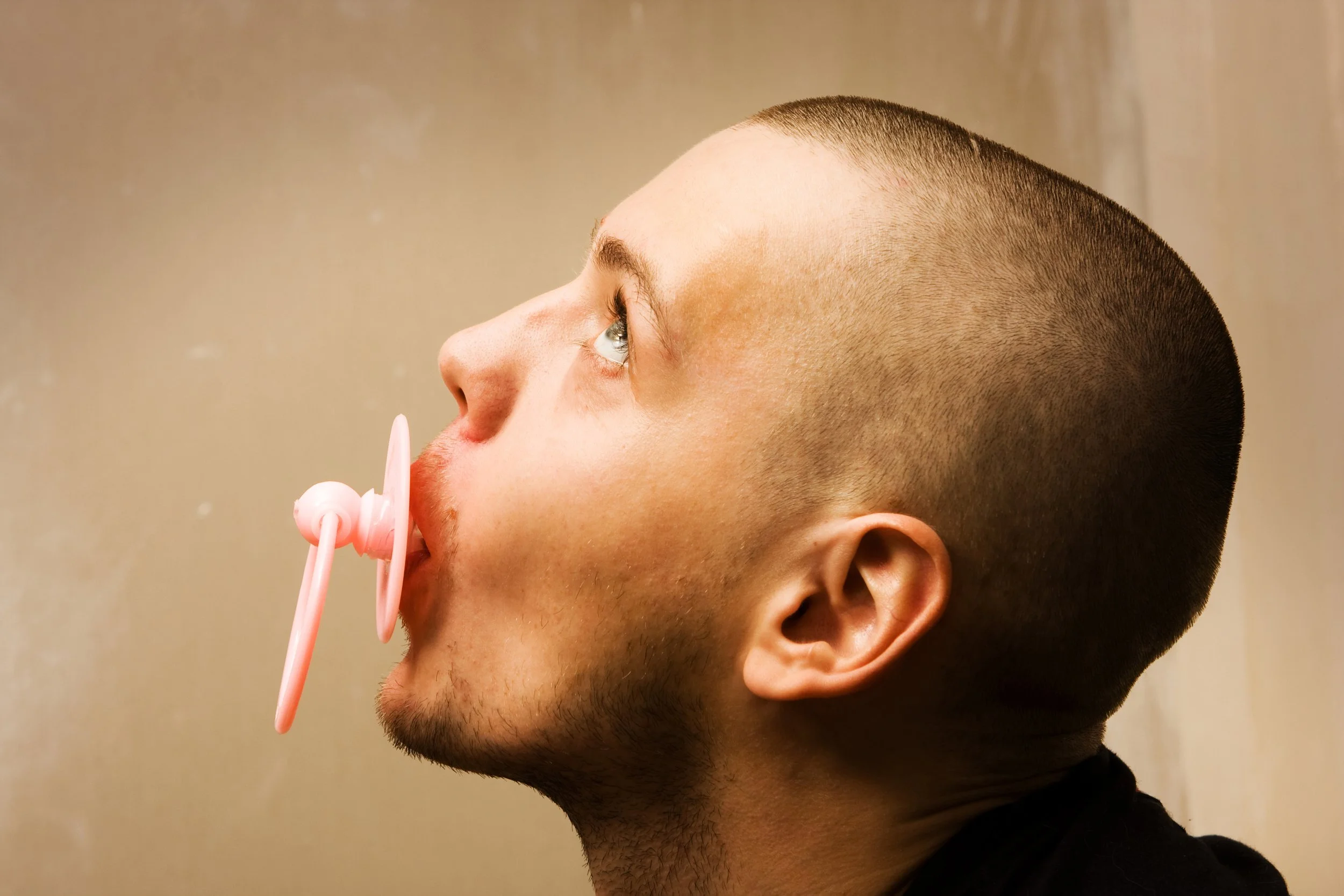
Image Description: A man with freshly shaven head is seen on his profile, sucking on a large pink pacifier, and his eyes are open, staring at the ceiling. He’s wearing a black T-shirt, and he has light stubble facial hair.
Thumbnail photo credit © Alberto Jorrin Rodriguez