
Narcissism in Germany
Has Western Modernity Led To a Self-Centered Society?
A recent study analyzing data from 45,000 people across 53 countries, identified Germany as having the highest levels of narcissism in the world. The interesting part of this study is that it revealed younger people showing higher scores in "grandiose narcissism" (admiration-seeking) and "narcissistic rivalry". Can we say, then, that Western modernity has shaped Germany into one of the most self-centered societies on Earth — and if so, what does that cost the people living inside it?
Some of my readers might think I hate Western modernity. But I do not. Modernity has brought us the Enlightenment, industrialization, secularization, and several other important milestones for the development of scientific and critical thinking, as well as the betterment of the human mind. As a so-called occultural scholar, however, I must point out how Western modernity also displays a problematic shadow side: the rise of capitalist nation-states and their colonialist power, paired together with the primacy of inequality, subjugation, and exploitation, conjoined by the emergence of abyssal thinking — a mode of thought that creates invisible, radical lines dividing reality into “this side” (visible/acceptable) and “the other side” (invisible/nonexistent). It emphasizes rationality, individual subjectivity, and progress, often viewing Europe as the center of development.
According to scholars such as Argentine semiotician and professor at Duke University Walter D. Mignolo, coloniality did not end when empires formally withdrew — it persists as the underlying logic that still organizes global hierarchies of knowledge, being, and power. It was Mignolo's contemporary, the Portuguese sociologist Boaventura de Sousa Santos, who gave this logic its most vivid image: abyssal thinking, the invisible line that divides the world into what can be known and what is simply erased from consideration.
I live this divide in my own skin.
I am Brazilian, and as of last November, I hold German citizenship too — an irony I have not fully digested yet. I have lived in Berlin for almost eight years, speak fluent German, hold a master's degree from Humboldt University, and I am still met, daily, with a wall of affective coldness that disguises itself as coolness and performs itself as superiority. Here, they call it Berliner Schnauze — literally "Berlin snout," a local idiom for blunt, brusque speech, worn almost as a badge of civic pride. I call it what it is: collective narcissism with a self-protective function.
Berlin isn't the exception. Berlin is the concentration.
I've also lived in the Netherlands — a country that is genuinely direct, so direct that some people find it rude. The difference is instructive: those who are truly direct don't need to defend themselves for it. Berliner Schnauze isn't directness. It's passive aggression wearing directness as a costume — narcissism in its most everyday, unexamined form.
The Charité knew this back in 2018. A study published in PLOS ONE, led by Prof. Stefan Röpke, compared narcissism scores between East and West Germany and found that people raised in the former West scored consistently higher than those from the former East — clear evidence that societal structures, not genetics, shape narcissism. With reunification, the West exported its ego eastward. Tellingly, the generation too young to remember the Wall — born after or barely school-aged in 1989 — shows identical narcissism levels across both former territories today. Capitalism finished the job reunification started.
And now, in 2025, a new study from the Michigan State University confirms on a global scale what many had already sensed: Germany ranks first in the world for narcissism — ahead even of the United States, which lands at sixteenth. The study measures two dimensions: admiration — the need to be perceived as exceptional — and rivalry — the drive to dominate and devalue others. I recognize both. I live both, daily.
This isn't a new discovery. Psychoanalysts Alexander and Margarete Mitscherlich diagnosed it back in 1967: Germany's inability to mourn. Not mourning the victims — that would be a moral demand. Mourning the collapse of its own ego-ideal, the one that shattered with the Third Reich. A society that cannot mourn cannot integrate. And what isn't integrated returns — as defensiveness, as grandiosity, as an inability to see in the Other anything but a threat, or a mirror to be broken rather than faced. Nearly sixty years later, Michigan State is measuring the same phenomenon with different instruments.
The question isn't whether. It's why. What psychic mechanism keeps a society from seeing itself — and makes it prefer to shatter the mirror instead?
Carl Jung described the shadow as the part of the personality the ego refuses to see, and therefore projects outward. What we reject, despise, and label as foreign in others is often exactly what we cannot bear in ourselves. Jung put it with a precision that hasn't dulled with time: projections turn the world into the replica of one's own unknown face.
On a collective level, the mechanism works the same way. A society that cannot integrate its own darkness projects it — onto outsiders, onto foreigners, onto whoever happens to be holding up the mirror. I am one such mirror. Not by choice, but because my presence asks a question the collective ego would rather not answer: what if this superiority is a defense?
Jung called the escalation of this ego-identification inflation — the state in which the self fuses with something larger than itself: an ideal, a national story, a self-image. Germany as the land of poets and thinkers. As export champion. As the morally rehabilitated nation that has done its historical homework. None of these are lies — but they are ego-ideals, and ego-ideals are exactly what conceals the shadow. The bigger the ideal, the deeper the shadow beneath it.
So what happens when the mirror shows up — the foreign body who calls the ideal into question simply by existing? It doesn't get looked at. It gets frozen out, filed as irrelevant, overlooked, met with a condescending kind of politeness. This isn't cruelty. It's self-protection. The narcissism Michigan State measured is also this: a collective ego that would rather not know itself.
Berlin is full of adults who get to stay teenagers. The system allows it — a level of state support unmatched almost anywhere else in Western Europe, shared-apartment culture, nightlife as a lifestyle, a city that has turned the provisional into an identity. People call this freedom. Analyst H.G. Baynes called it the provisional life: the state of never quite arriving, because arriving would mean choosing — a career, a relationship, a direction. A self.
Marie-Louise von Franz named this pattern the puer aeternus — the eternal youth who never quite grows up. I use her term, but I explicitly reject her framing of homosexuality as arrested development. That reading isn't just scientifically outdated — it's a projection von Franz herself doesn't seem to have noticed she was making. What interests me in the concept is something else entirely: not sexuality, but one's relationship to one's own life force. In my sense, the puer aeternus isn't the man who loves men. It's the person who cannot embody the erotic — in Audre Lorde's sense of that word. Someone stuck in permanent adolescence survives on other people's energy. He cannot give what he doesn't have.
This closes a loop back to the state-as-mother: a system that structurally enables the provisional life produces exactly this incapacity. Someone never forced to choose never develops agency. Someone perpetually provided for — emotionally, bureaucratically, materially — never learns to provide for themselves.
I speak from experience, and I say that on purpose. I've drawn many men who fit this pattern. What they were looking for in me was something they couldn't find in themselves: authenticity, erotic self-possession, the capacity to be fully present. I recognized it, and it moved me. But because they lacked the agency to develop those qualities themselves, the relationships curdled into codependency — energetically vampiric, to put it plainly. I was the mirror. And here, too, the mirror eventually got smashed.
What did these men lack? It took me a long time to find the word.
In 1978, Audre Lorde gave a talk that would later appear in her book Sister Outsider — “Uses of the Erotic: The Erotic as Power.“ It's still barely read in Germany. In it, she defines the erotic not as sexuality, but as the deepest source of internal knowledge: the capacity to feel fully, to be fully present, to act from one's own depths rather than from fear or duty. For Lorde, the erotic is the opposite of numbness. It's aliveness as a way of knowing.
She also argues that suppressing the erotic serves a political function. Someone who cannot feel what they actually want falls in line. Someone cut off from their own depth needs external structures to function at all. I don't read this as a narrowly feminist claim — I read it as a diagnosis of social pathology. And I recognize it.
What I observe in German bodies isn't a cultural style. It's the result of a systematic estrangement from exactly what Lorde is describing. Narcissism is also this: the shell that remains once the core has been repressed. The facade of superiority, built precisely where aliveness is missing.
Latin American cultures are often accused of excessive dependency — men living with their parents well past thirty, never quite cutting the cord. That's true, and I know it from my own life. But this maternal embeddedness has a flip side rarely named: it produces people who know community in the body. Who don't have to fake warmth, because they were taught how to receive it. Who don't manage contact — they inhabit it.
Germany goes the opposite direction — and paradoxically arrives at the same place. Here, separation is forced early, often before the nervous system is ready. Attachment research has documented this for decades: early affective deprivation produces avoidant attachment — a pattern in which closeness itself registers as threat. The body learns: feeling is dangerous. Not feeling is control. And control is superiority.
I've made this observation once already, and I'll make it again, because it's the core of everything: what I notice in German bodies isn't a cultural style. I say this as someone who spent twenty years on stage learning to read bodies. It's a nervous system stuck in permanent defense mode. Stephen Porges calls this a reduced vagal tone: the body remains in a chronic state of readiness that allows for neither real connection nor real rest. Not coldness as character. Coldness as an inherited response to a world that was never warm enough.
And then the state steps in. The Bundesagentur für Arbeit. The Jobcenter. The endless paperwork. The state takes over the mother’s role — not her warmth, but her function. It feeds, regulates, punishes, rewards. It provides structure where there was no attachment. This isn’t care. It's bureaucracy as attachment substitute — and it explains why so many Germans relate to the state with the same ambivalence you’d find in a disrupted parent-child relationship: dependent and resentful at once.
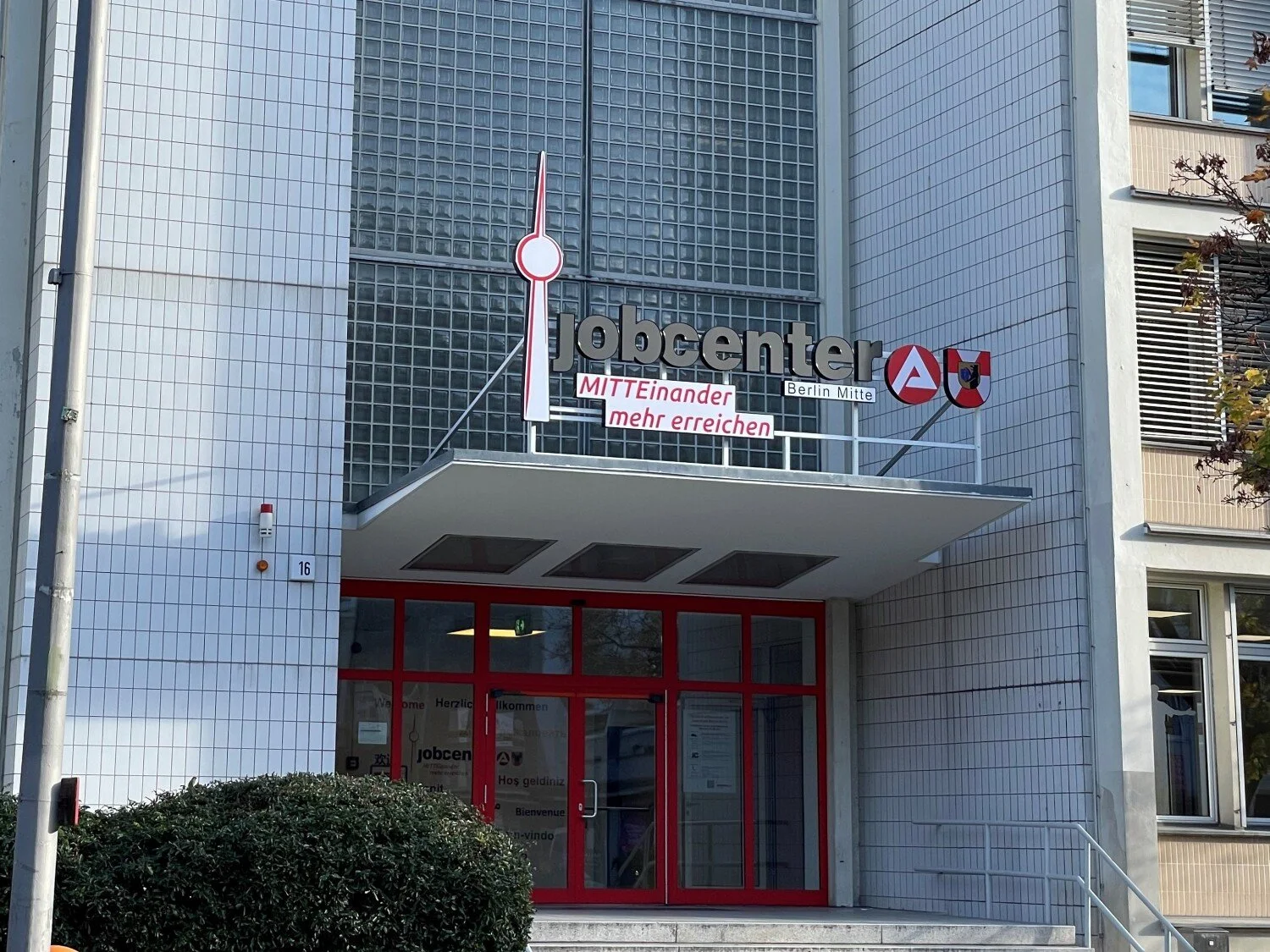
Image Description: Entrance of the Jobcenter Berlin Mitte office building, with a gray tiled facade and a sign reading "Jobcenter Berlin Mitte" featuring a stylized Berlin TV Tower icon. Below it, a banner reads "MITTEinander mehr erreichen." The entrance has red door frames and multilingual welcome signs visible through the glass.
Copyright: Jobcenter Berlin Mitte
Germany has silenced me. In restaurants, because I speak too loudly. On the street, because I’m too much — too present, too uncontained, too unwilling to fold myself into this city’s affective economy. Men approach me — gay, straight, somewhere in between, somewhere else entirely — with an intensity I recognize from a very different experience: the experience of being a woman on streets that are supposedly safe. What they see in me can’t quite be named, but it can’t be ignored either. It overflows. It overwhelms. It produces fear or admiration — never anything in between, never anything simple.
I'm attractive enough to be treated as “sexotic” — desired as a body, as a temperament, as a screen for everything one doesn’t permit oneself. But smart enough to write something like this? For that I need a stamp. A degree from a German university, the sign-off of a Teutonic institution certifying that this body is also allowed to think.
I know how that sounds. Narcissistic. And that’s exactly the point: I can look into that mirror. I can see what’s grandiose in me, what’s wounded, what’s compensating. That capacity — not the grandiosity itself, but the ability to look at it — is what I miss most in this country.
This is what the foreign body does: it makes visible what a society refuses to see in itself. Not by intention, but because its mere existence asks a question the collective ego won’t answer. I didn’t choose to be this question. I am the question.
Perhaps this incongruity is itself instructive. I am not a native German speaker. I write and speak with the help of dictionaries, translation software, and years of hard-won fluency — an intelligence assembled rather than inherited. I stand, linguistically as much as culturally, on the far side of the line Santos describes: audible, but never quite legible on the terms the center sets. And it is precisely from that position that certain things become visible which those fully absorbed into the “legitimate” side can no longer see.
So — has Western modernity led to a self-centered society? The honest answer isn't simply yes or no: modernity has always carried this possibility inside itself. The same rationalizing impulse that produced the Enlightenment's critical thinking also produced abyssal thinking — the invisible line deciding whose interiority counts as fully human and whose doesn't. A society organized around that line will always be prone to mistaking its own reflection for objective superiority, because the line itself was drawn to make that mistake feel like knowledge.
Germany isn't an aberration of Western modernity. It's one of its most legible expressions. It industrialized and rationalized its bureaucracy earlier and more thoroughly than its neighbors, and then, having produced the twentieth century's most extreme catastrophe out of that same rationalizing impulse, chose administration over mourning as its way of moving forward. Reunification didn't undo this — it redistributed it, exporting one half of the country's unprocessed ego onto the other until both sides converged on the same psychological profile. What Michigan State measured in 2025 isn't a national personality flaw. It's the residue of a very specific modern history: Enlightenment rationality, unmetabolized trauma, bureaucratic attachment, and abyssal thinking, compounded over two centuries.
I remain a foreign body inside that structure — one small, persistent mirror a self-centered society would rather not look into. But the mirror isn't the argument. The argument is that societies built on rational self-sufficiency eventually mistake the absence of feeling for strength, and the absence of self-knowledge for superiority. Western modernity didn't have to end here. In Germany, it did — and the country is still deciding whether it wants to know that.