
Twin Flames: the love that cannot be
Highly romanticized in contemporary popular culture — but deeply misunderstood — the concept of twin flames seems to be making an occultural comeback. Not for the faint-hearted, this seems to be more of an “over the rainbow” than run-of-the-mill love story.
Look, I get it. Emerald Fennell did what purists and academics hate: she dared to adapt a paramount piece of literature into her own concept and screenplay. Wuthering Heights by Emily Brontë, alas 2.0. How dare she? I am not going to enter the the debates on race and class that were overlooked in Fennell’s adaptation, not because it is not important work to be done, but simply because it has been thought upon by several writers, critics and journalists already.
My interest here is to extrapolate and re-signify Fennell’s courageous adaptation into the realm of what the original novel itself managed to do: create and embody the occultural force of twin flames as a romantic archetype.
What one sees in the main body of the film — after the prologue established Cathy’s and Heathcliff’s relationship and connection since childhood — is a scene between Cathy and her servant, confidante, and surrogate mother Nelly, in which the anti-heroine confides in her companion on Heathcliff that:
“I love him.
Not because he’s handsome, Nelly, but because he’s… more myself than I am.”

Image Description: The poster of Emerald Fennell’s Wuthering Heights depicts Margot Robbie as Cathy and Jacob Elordi as Heathcliff in a close embrace that is an almost-kiss translating both their fiery passion, as well as their inevitable tragicness.
I. A love older than Psychology
Before we go any further, let me be clear about something: the twin flame concept is not a New Age invention. It is not a TikTok trend, not a self-help rebranding, and not — as some clinical voices would have it — simply a romantic gloss on attachment disorder. The twin flame is a cosmological notion, and it has been with us for as long as humans have tried to put language to the most disorienting of all experiences: the recognition of another as something that is, in some undefinable way, also oneself.
Plato's Symposium (c. 380 BCE) gives us Aristophanes' speech — one of Western literature's first sustained meditations on the soul's longing for its other half. In it, humans were once spherical, double-bodied creatures split apart by Zeus as punishment for their hubris; love, Aristophanes argues, is nothing other than this severed being's search for reintegration. Whether one reads this as myth or metaphysics, the phenomenology it describes is precise: the recognition that feels like return.
The Hebrew Song of Songs — interpreted allegorically in both Rabbinic and Christian traditions — renders this longing in ecstatic, erotic verse: "I am my beloved's, and my beloved is mine." The Gnostics, particularly the Valentinian school, developed an elaborate theology of syzygies — paired spiritual beings whose reunification was the very drama of cosmic redemption. The soul's exile from its counterpart was the Fall; reunion was salvation. In the Gnostic imagination, love was not a distraction from the spiritual path. It was the spiritual path.
Medieval alchemy gave us the coniunctio: the sacred marriage of Sol and Luna, the masculine and feminine principles whose union produced the lapis philosophorum — the philosopher's stone. Paracelsus, among others, understood this not merely symbolically but as a living energetic reality encoded in matter itself. The alchemical tradition did not speak the language of "relationships." It spoke the language of transmutation.
Emanuel Swedenborg (1688–1772), in Arcana Cœlestia and his late theological writings, described marriages in the afterlife as the progressive unification of two souls whose spiritual correspondence deepens across eternity — a vision that profoundly influenced the 19th-century Spiritualist movement. Helena Blavatsky, Annie Besant, and C.W. Leadbeater translated these ideas into Theosophical frameworks of soul evolution, spiritual hierarchies, and complementary counterparts that would eventually feed directly into the modern twin flame vocabulary.
This is, in other words, an extraordinarily long lineage. When Orpheus descends into the underworld for Eurydice, it is not co-dependency. When Romeo dies at Juliet's side in Shakespeare's crypt, it is not anxious attachment. When Dante writes, at the end of the Commedia, of the love that moves the sun and the other stars, he is not describing an enmeshed relationship. These are, each of them, attempts to render something that exceeds the frame of human psychology entirely — something that announces itself as cosmic.
And that is precisely what is at stake when we talk about twin flames today.
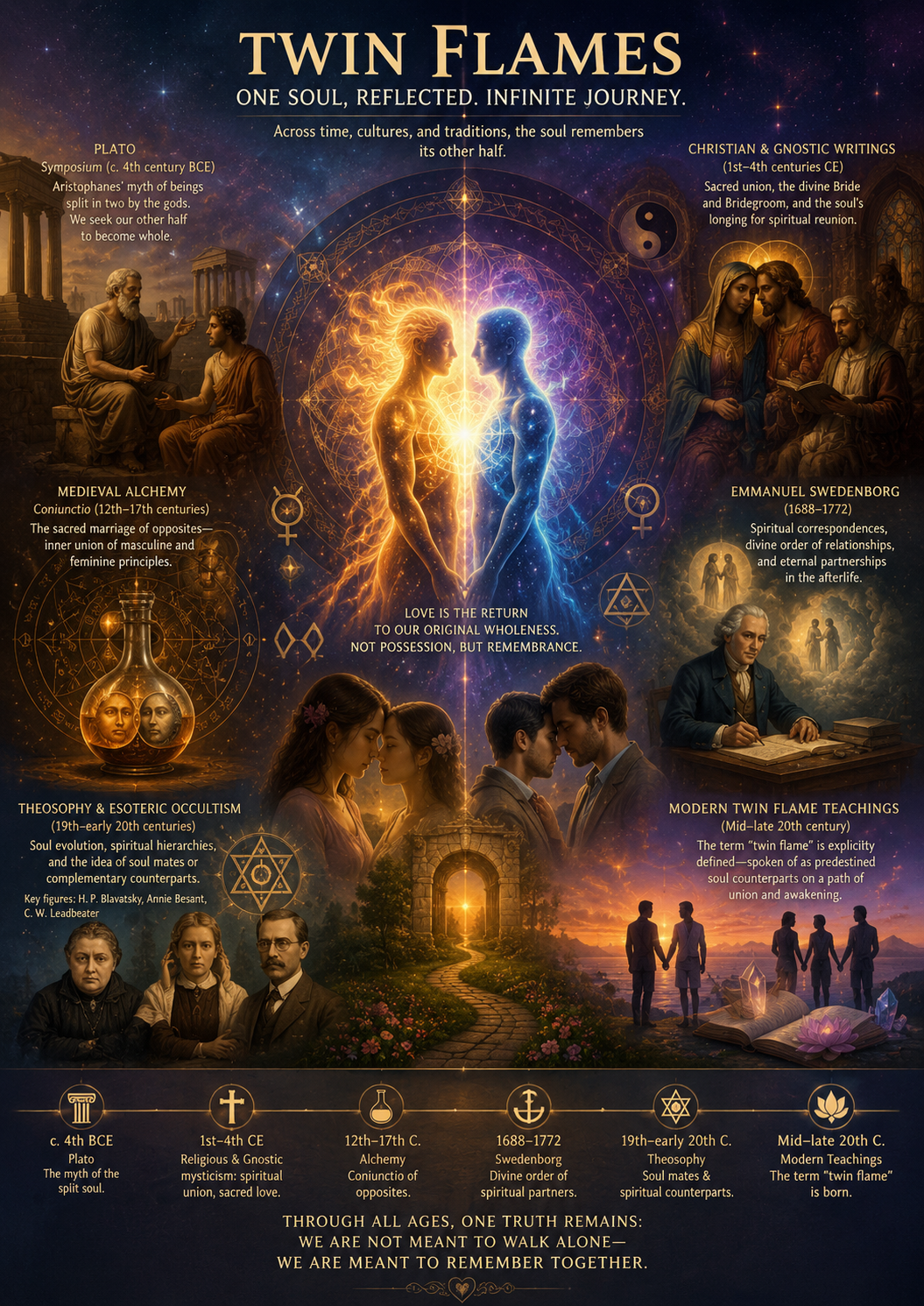
Image Description: Twin Flames are seen here as an occultural archetype across time, born and re-enacted in spiritual and philosophical wisdom.
Credit: ChatGPT
II. What the energy field knows
Barbara Ann Brennan's Hands of Light: A Guide to Healing Through the Human Energy Field (1988) offers one of the most rigorous attempts to map the energetic reality that twin flame encounters make viscerally apparent. Brennan, a former NASA physicist turned healer and teacher, describes the human aura as a layered field of light that extends beyond the physical body — and which carries, in its structured bands, the full imprint of a person's emotional, mental, and spiritual history. Crucially for our purposes, she observes that two people who share deep soul-level connection produce what she terms energy field interactions that are qualitatively unlike those of ordinary relationship: a mutual amplification, a resonance that can be felt physically in the chest and solar plexus, a sense that one's own field is being mirrored and activated by the other's.
This is not metaphor. Brennan's clinical observations — drawn from decades of hands-on healing work — suggest that what we call "recognition" in a twin flame encounter is a literal energetic phenomenon: the field knows before the mind does. The activation that follows — the intensity, the disorientation, the apparent impossibility of simply walking away — is not pathology. It is the energy body responding to contact with a frequency it has, at some level, been oriented toward for a very long time.
Elizabeth Clare Prophet's Soul Mates and Twin Flames: The Spiritual Dimension of Love and Relationships (1999) frames this in theological language that is no less precise for being devotional. Prophet draws a careful distinction between three categories of deep connection — the twin flame (the other half of one's divine origin, created from the same "white fire body"), the soul mate (a kindred soul working toward the same karmic mastery), and the karmic partner (drawn together for the balancing of specific relational debts). The twin flame connection, in her framework, is not primarily a romantic relationship at all. It is an initiatory encounter — one that activates in both parties the full weight of their accumulated karma precisely because the shared blueprint means that nothing can be hidden. What you carry, your twin flame amplifies. What they carry, you feel in your own body as if it were your own.
This is exactly why the encounter so often feels unbearable. Not because something is wrong with it, but because something is right — because it is working.
Alexx Shaw's The Soul Family: A Guide to Karmic Relationships, Soulmates, Soul Tribes, and Twin Flames (2023) extends this into contemporary spiritual-scientific language, drawing on quantum physics, epigenetics, string theory, and Samkhya philosophy to propose that the Soul Family is a pre-incarnational agreement — a chosen curriculum of energetic lessons that each member of the soul group carries into physical embodiment. Shaw's framework is notable for its insistence on non-attachment: the twin flame connection is not a promise of romantic union. It is an assignment. Its purpose is the healing of ancestral wounds — patterns of fear, abandonment, unworthiness, and control — that cannot be accessed or metabolized through any other encounter, precisely because the mirror is too accurate to look away from.
That last point is, I think, the key that clinical psychology most consistently misses.
III. The Dr. Ramani question
I want to be clear here: I have enormous respect for Dr. Ramani Durvasula. Her work on narcissistic personality disorder has been genuinely important — including, personally, to me. Her ability to translate clinical knowledge into accessible public education has helped a great many people recognize and name dynamics that were quietly destroying them. That matters.
And yet.
When Dr. Ramani addresses twin flames — as she has on several occasions, including in videos where she maps the concept onto Narcissistic Personality Disorder (NPD) and antagonistic relationship dynamics — she does something that I believe reflects an epistemological limitation rather than a clinical error: she reads a cosmological phenomenon through a psychological lens, and then concludes that because the psychological reading reveals pathology, the phenomenon itself must be pathological.
The comparison is instructive precisely because it is partially correct. Yes, twin flame dynamics can resemble the anxious-avoidant attachment cycle. Yes, the runner-chaser pattern is structurally similar to what we observe in relationships where one partner exhibits narcissistic traits and the other collapses into a fawn response. Yes, the intensity of the connection — the sense that this person is irreplaceable, that life without them is unlivable — can be, and has been, weaponized by those who wish to exploit it.
All of this is true. And none of it is the whole story.
The problem with reducing twin flame phenomenology to a trauma bond is the same as the problem with reducing mystical experience to temporal lobe activity. The description is not wrong, exactly. It simply does not account for what the experience is for. Anxiety and avoidance are real features of the twin flame dynamic — but they are symptoms of the ancestral wound that the encounter is designed to surface and purify, not evidence that the encounter itself is the wound. The mirror dynamic that makes a twin flame connection so destabilizing is precisely its mechanism: it confronts both parties with the unresolved grief, the armoring, the places where love was learned as conditional or dangerous.
Cat's Sacred Soul Rising — one of the more grounded and genuinely illuminating voices in the current online conversation about twin flames — puts it well: the twin flame is not your person. The twin flame is your teacher. The union being worked toward is not, first and foremost, a romantic partnership. It is the integration of the self — what the alchemical tradition called the coniunctio happening within rather than between. The outer encounter with the twin flame catalyzes the inner marriage. That inner marriage is the point.
What Dr. Ramani's framework cannot hold is the possibility that something can be simultaneously a genuine spiritual awakening catalyst and phenomenologically indistinguishable from a dysfunctional dynamic from the outside. The spiritual-scientific tradition has always insisted on this paradox. The dark night of the soul, after all, looks like depression. The kundalini awakening looks like a breakdown. The twin flame encounter looks like trauma bonding. Naming the outer form does not exhaust the inner function.
This is not an argument against discernment. It is an argument for a more capacious epistemology.
IV. When the concept is weaponized
None of which means there is nothing to be concerned about. Netflix's Escaping Twin Flames (2023) documents what happens when the vocabulary of spiritual awakening is captured by a cult infrastructure: in the Twin Flames Universe community built by Jeff and Shaleia Divine, the language of divine partnership was systematically used to coerce, control, and in some cases forcibly alter the gender identities of members who did not conform to the community's preferred pairings. People were told their specific assigned partner was their only possible romantic partnership. Doubt was reframed as spiritual resistance. Leaving the community was framed as abandoning one's divine mission.
This is not twin flames. This is the predatory colonization of a genuine spiritual vocabulary by people with no spiritual authority and a great deal of financial incentive. It is worth naming precisely because the misuse is so consequential — and because distinguishing the misuse from the thing itself is exactly the kind of critical spiritual literacy that the conversation most needs right now.
The genuine twin flame tradition — from the Gnostic syzygies to Elizabeth Clare Prophet to Barbara Ann Brennan to Alexx Shaw — has never insisted on a single identified human partner as the sole vehicle of spiritual connection. It has always, in its most coherent articulations, pointed inward first. The outer encounter is a catalyst. The work is yours. No guru, no community, no online certification can tell you who your twin flame is. And any framework that claims otherwise is not offering you spiritual truth. It is offering you a new attachment, which is precisely the opposite of what the encounter is meant to teach.
V. Half Man and the question no one asks
Richard Gadd's Half Man (HBO/BBC, 2026) is not, on any surface reading, a love story. It is a story about male violence, about the decades-long orbit of two men — stepbrothers Niall Kennedy (Jamie Bell) and Ruben Pallister (Gadd himself, barely recognizable after a physical transformation) — whose bond is forged in childhood trauma and sustained through thirty years of mutual damage, fierce protectiveness, and an intimacy that neither can name nor survive. It begins at Niall's wedding, where Ruben arrives uninvited, and ends with both men dead.
And yet: Brazilian film critic Isabela Boscov — one of the sharpest and most culturally embedded voices in contemporary audiovisual criticism, with over a million subscribers on YouTube — argues that Half Man punches harder than Richard Gadd’s debut Baby Reindeer (2024), and that the former’s extraordinary force comes precisely from the layered, irreducible complexity of what Niall and Ruben are to each other. They are accidental brothers: not by blood, but by the romantic union of their mothers, Lori and Maura — lesbian lovers whose household threw two profoundly wounded boys together into an improvised family neither had chosen.
Ruben's father is alcoholic and abusive; Niall's is dead. Each finds in the other a fraternal quality that is simultaneously friendship and foe — a bond that fills the father-shaped void while replicating its violence. Boscov notes how the show carries a remarkable density of themes — class, abuse, abandonment, internalized and external homophobia, a search for stability that never fully arrives, and a constant, grinding desperation — and that both Ruben and Niall represent archetypes of masculinity that are not easily comprehended, and that could be lazily dismissed as "toxic" if not read in their full interpretive depth, particularly as rendered in Gadd's and Jamie Bell's performances. In Boscov's reading, the show demands exactly the kind of interpretive seriousness that the twin flame framework, at its best, also demands: the willingness to sit with what cannot be resolved, and to look for meaning beneath the surface of damage. It is precisely that depth I want to insist on here. Not toxic masculinity in the clinical sense — though it is also that — but something closer to a twin flame encounter: two halves of a divided whole, incomplete without each other and incapable of surviving with or without each other, at least not within the unhealed structures of patriarchal selfhood they have both inherited.
The show's own logic supports this reading. Gadd has described their bond as "idolatry mixed with love mixed with hatred mixed with adoration and need" — a formulation that maps almost precisely onto what the twin flame tradition names as the runner-chaser dynamic in its most intensified, uncontainerized form. Niall — played in its teenage iteration by an incredible Mitchell Robertson — is the head: bookish, restrained, terrified of his own desires, constitutionally incapable of confronting Ruben directly. Ruben — played in its younger version by charming Stuart Campbell — is the body: explosive, fiercely loyal, operating entirely from wound and impulse, protecting Niall with the same hands he uses to destroy him. They are, as the show's title insists, each a half man — and together they add up not to wholeness but to annihilation, precisely because the inner work that the twin flame encounter demands has never been done by either of them.
In the finale, through prison glass, Niall finally comes out to Ruben — the person he has always been most terrified to tell. And Ruben, for perhaps the first time, is nothing short of accepting. Looking into Niall's eyes, he says: "You've wasted your whole life dancing to other people's tunes, but you've never had the rhythm." It is an annihilating moment of seeing — the twin flame mirror at its most precise. Ruben has always known who Niall is. Niall has spent thirty years being unable to let that knowledge in, because being truly seen by Ruben meant being truly seen — full stop. And he was not yet ready to bear it.
Their connection is sealed by betrayal: Niall reveals to Ruben, in that final prison encounter, that he is the biological father of the child Ruben had believed was his own. What follows is the show's final act of violence — Ruben kills Niall at his wedding, and dies shortly after. Both men carried, in the end, the thing that should have been transformed between them. Instead of purification, combustion.
What Gadd's work illuminates — and what I think makes it genuinely important for this conversation — is the question of male loneliness as a spiritual emergency. The twin flame tradition has always understood that its deeper purpose is the elevation of collective consciousness: two souls incarnating together to teach, by the example of their encounter, a higher template of love. The patriarchal wound — the conditioning that teaches men that vulnerability is weakness, that need is shameful, that love must be earned through performance or absorbed through violence — is precisely the ancestral inheritance that the twin flame dynamic surfaces and demands that the masculine principle metabolize. Niall and Ruben are the twin flame encounter without the spiritual container. The activation without the integration. What the fire does when there is no hearth, and two men have been given every wound and none of the language.
That Gadd chose to make Ruben die at Niall's wedding — the very ritual of union from which he is structurally excluded — is not incidental. The sacred marriage that was never possible in this lifetime. The alchemical coniunctio deferred, again, to whatever comes next.
VI. "More myself than I am"
It is through Jacob Elordi’s powerful performance and final soliloquy that the cinematic reinterpretation of Wuthering Heights concludes its thesis (and if you are not weeping a stream thicker than the Niagara Falls by this point of the film, there is something deeply wrong with you):
„My love, my love.
My darling pain. Only do not go. No.
No, no, do not go.
It is unutterable.
I cannot live without my life.
I cannot live without my soul.
You… You said I killed you.
Haunt me then.
Be with me always.
Take any form.
Drive me mad.“
As the film concludes, with a scene played by the younger version of Heathcliff (performed by Adolescence’s breakout star Owen Cooper), Heathcliff is seen speaking to a sleeping Cathy, as they share a bed together:
“Catherine Earnshaw… I will love you until the day that I die… and forever after.”
Brontë, Plato, the Gnostics, the alchemists, Swedenborg, Elizabeth Clare Prophet, Barbara Ann Brennan, Alexx Shaw — and now Emerald Fennell and Richard Gadd. They are all trying to describe the same thing: an encounter that refuses to be metabolized by ordinary categories of love, because it is not, at its root, an ordinary love. It is a cosmological event wearing a human face. Its purpose is not happiness in any comfortable sense. Its purpose is remembering — the soul's recognition of its own wholeness, refracted through the unbearable clarity of another.
That the encounter is also, often, painful beyond words is not a reason to pathologize it. It is a reason to approach it with the seriousness it demands: not as a relationship to be optimized, but as an initiation to be survived, integrated, and — if one is very fortunate, and very honest — transformed by.
The love that cannot be is, perhaps, the only love that truly is.
baba nam kevalam ∞ love is all there is